
Quick commercial: Join me live in Kuala Lumpur for the 12th ICIS Asian Surfactants Conference (https://events.icis.com/website/14105/) , co-produced by me on October 27 – 28th, with the one day training on October 26th. Sign up now, please. We will sell out the space.
End of Commercials.
The News:
Stepan and Unilever announced quarterly results, so let’s jump right in.
Stepan announced Q2 results on July 29th. They were good and the market liked what they heard, pushing the stock up from around 57 – 58ish to $65 where it is as I write this on July 30th. That puts the stock back almost to its February high of the year of $67. It’s still a ways off the COVID fueled highs ($125 +) of 2021 but headed in the right direction. Here’s the 5-day chart.
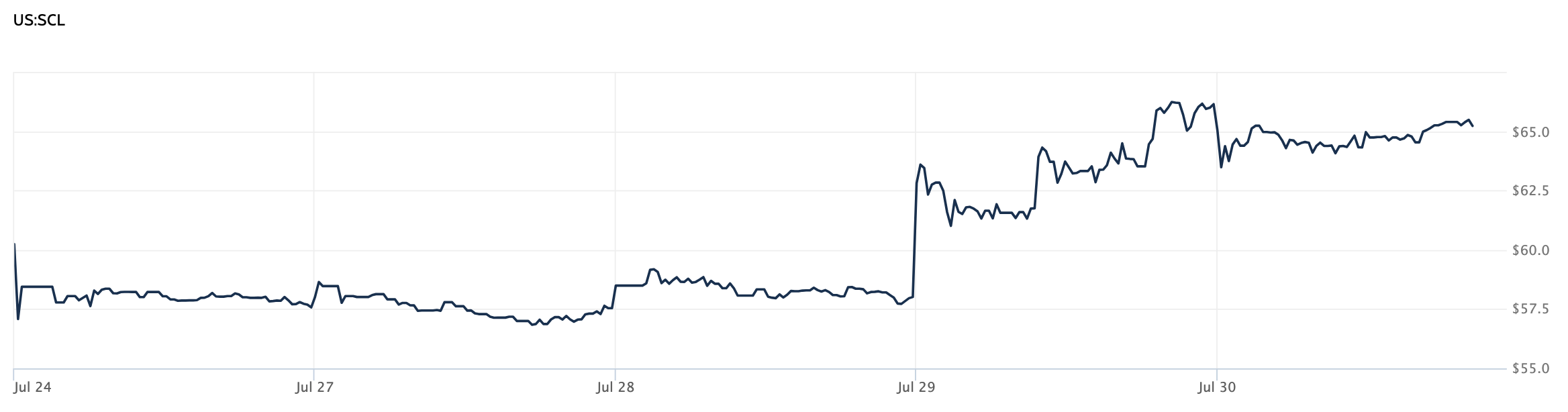
Nice step up!
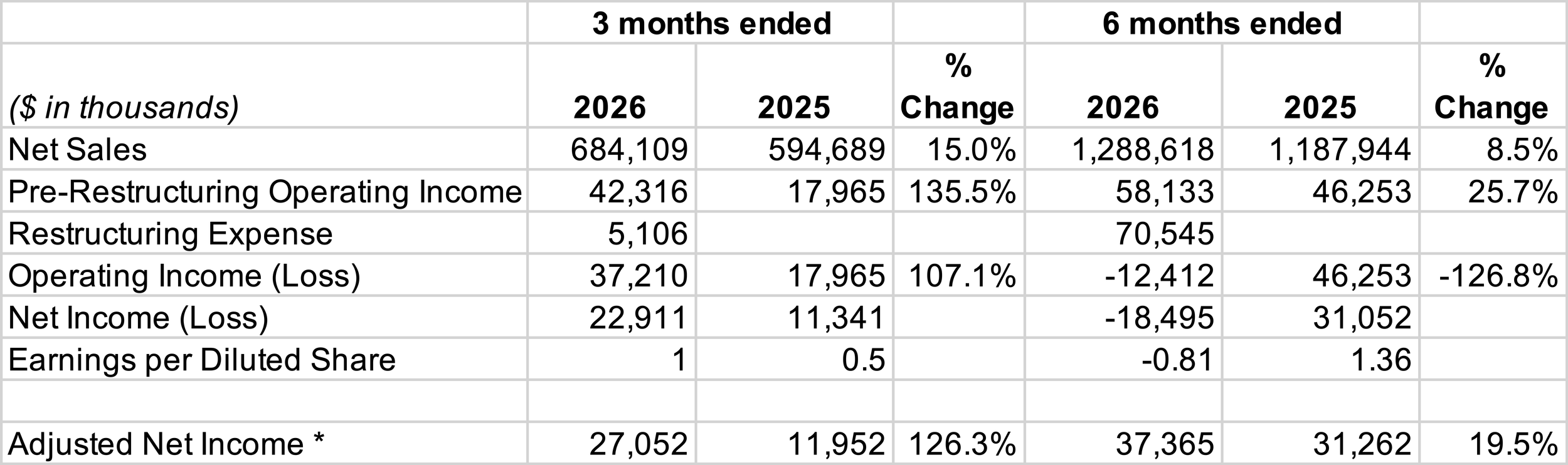
Here’s part 1 of the box score. Good growth in sales on the quarter and half year vs 2025. And notably, pre-restructuring charges, very strong growth in operating income and net income. This is what the market has been looking for.
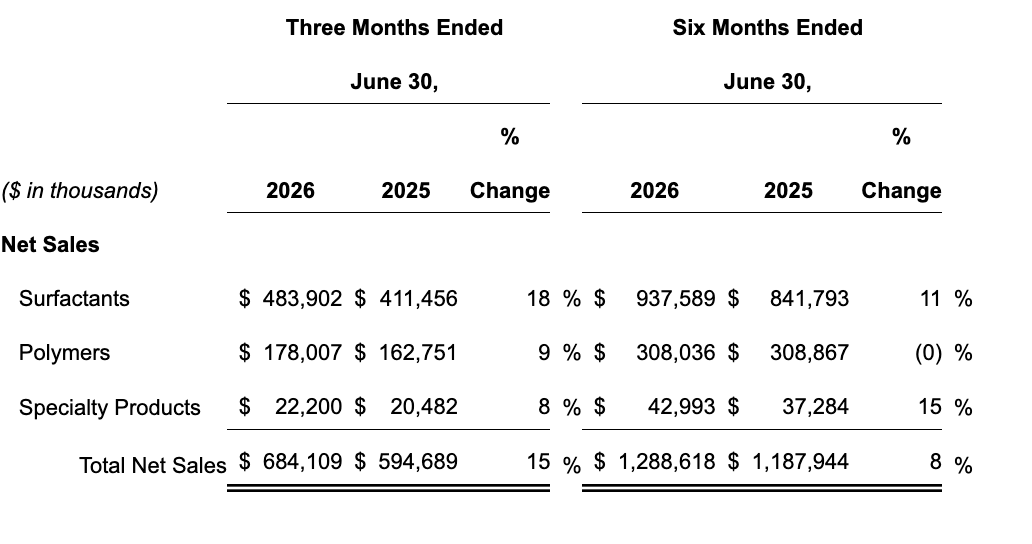
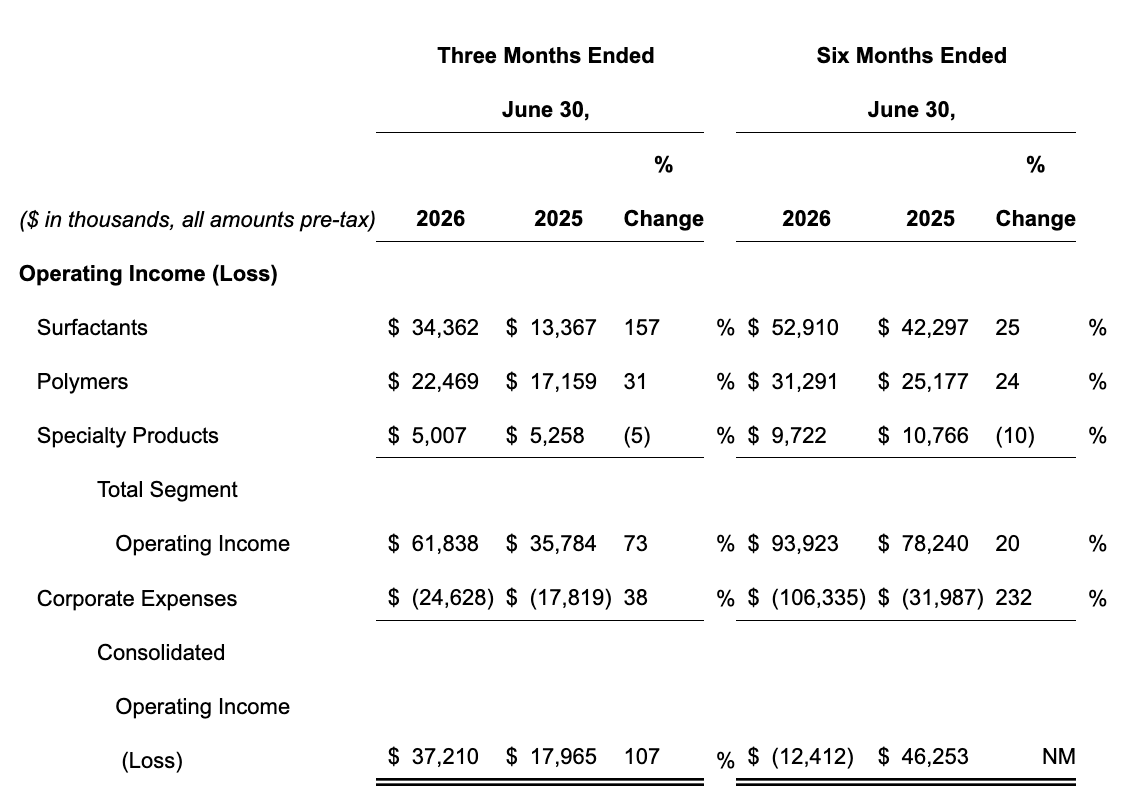
And here’s what’s happening in the segments. Sales, income and EBITA growth powered largely by surfactants. And this is what the company had to say about that business. “Surfactant net sales were $483.9 million for the quarter, up 18% versus the prior year. Selling prices were up 12% primarily due to pass through of higher raw material costs, improved product and customer mix, along with pricing actions. Global Sales volume was up 2% and organic sales volume increased 7%. All global regions recognized organic volume growth and our strategic end markets combined grew high single digits. Foreign currency translation positively impacted net sales by 4%. Surfactant adjusted EBITDA(2) for the quarter increased $20.4 million, or 59%, versus the prior year. This increase was primarily due to sales volume growth and margin recovery.”
Here are those segment box scores.
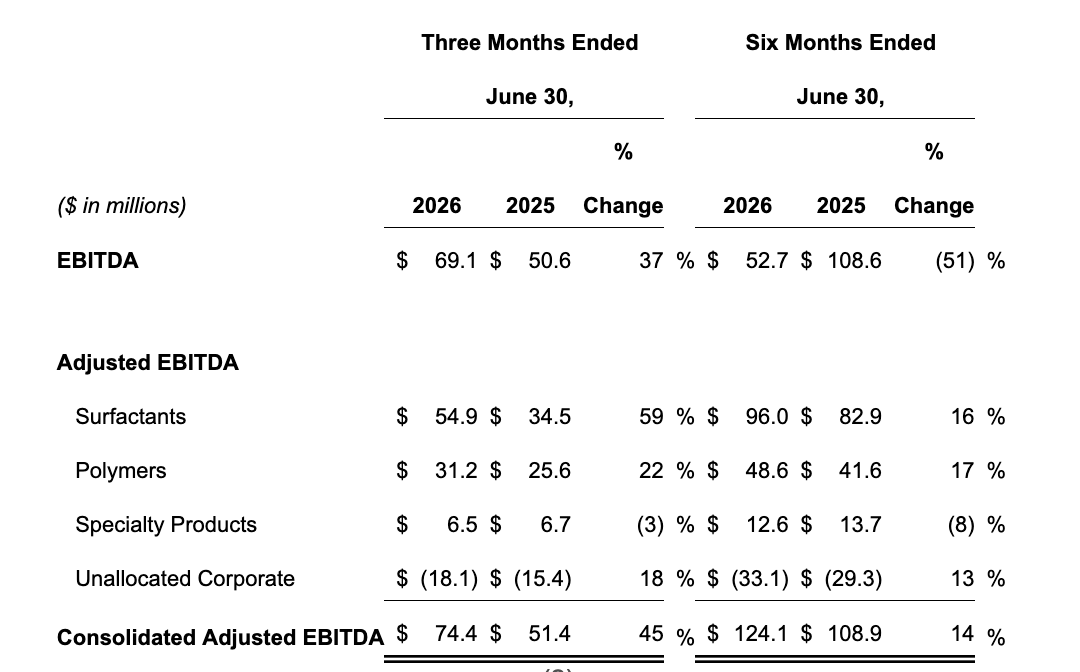
Some key points to note from the call.:
•Project Catalyst Execution: Cost savings from the Project Catalyst program remain on track ($100M in 2 years). The initiative focuses on footprint optimization, operational efficiency, and organizational restructuring.
•Footprint Optimization:
⚬ Completed the closure of the Fieldsboro, New Jersey facility.
⚬ Decommissioned select production assets at the Millsdale, Illinois and Stalybridge, United Kingdom sites.
⚬ Consolidated production volumes into higher-efficiency manufacturing sites across the global network.
⚬ Advanced an agreement to sell non-productive land adjacent to the Joliet, Illinois plant, subject to customary closing conditions.
•Workforce Restructuring: Announced a planned reduction of approximately 100 salaried positions globally, to be executed primarily during the third quarter.
•Customer Pre-Buying Effect: Geopolitical conflict near the Strait of Hormuz and raw material price volatility prompted some customers to shift from "just-in-time" to "just-in-case" inventory management, pulling forward volume demand into the second quarter.
•Operational Performance: Manufacturing reliability improved across key facilities. The Pasadena, Texas plant continued its production ramp-up, delivering higher tolling cost savings than initial estimates.
Surfactants Business Performance:
•Volume Growth Drivers: Organic volume expansion was broad-based across all end-use markets and geographic regions. Key growth drivers included:
⚬ Commercial and industrial cleaning
⚬ Consumer laundry
⚬ Construction and industrial applications
⚬ Oilfield chemical solutions
•Regional Dynamics:
⚬ North America & Asia: Earnings improved due to higher sales volume, benefits from Project Catalyst, and the resolution of first-quarter plant timing and fixed-cost absorption challenges.
⚬ Latin America: Volume grew by double digits organically, supported by disciplined contract execution and margin recovery actions.
⚬ Europe: Volume expanded modestly, anchored by laundry, household/institutional cleaning, and industrial channels.
•Commercial Strategy & Customer Expansion: North American surfactants expanded reach within tier-two and tier-three customer segments, commercializing hundreds of new customer-product combinations during the first half of the year.
•Margin & Pricing Execution: Contractual cost pass-through mechanisms and targeted pricing actions offset elevated raw material costs, enabling margin recovery across primary surfactant product lines.
As usual the especially the Q&A section of the call was very informative. Here are the highlights.
•Because of the volume pull-forward, third-quarter earnings are expected to be slightly lower than second-quarter levels. However, accelerating cost savings from Project Catalyst will support second-half performance, full-year earnings growth, and positive free cash flow generation.
•Production and delivery timing delays in Asia during the first quarter reversed in the second quarter as anticipated, providing a timing benefit alongside underlying organic demand growth.
•North American surfactants added over 500 new customer-product combinations during the first half of the year, particularly among tier-two and tier-three accounts. Oilfield surfactants delivered double-digit volume growth, while agricultural surfactants grew in low single digits following strong first-quarter volume.
•The Pasadena facility is fully constructed, operating safely, and continuing its production ramp-up. The plant delivered higher tolling cost savings than originally budgeted for the year. Facility utilization is currently at 75% to 80% capacity, with full utilization projected over upcoming quarters.
So – good for Stepan. Project Catalyst ($100M cost saving in 2 years) is humming along - $60M seems to be in the bag, no problem, this year - and the company seems to be on the improvement path. Lotta late nights and early mornings and airline miles and stress, I’m sure. Stay fit and eat properly, guys. Results are good to see.
Unilever also had decent first half results and so the market gave the stock a 6.4% pop – as shown here.
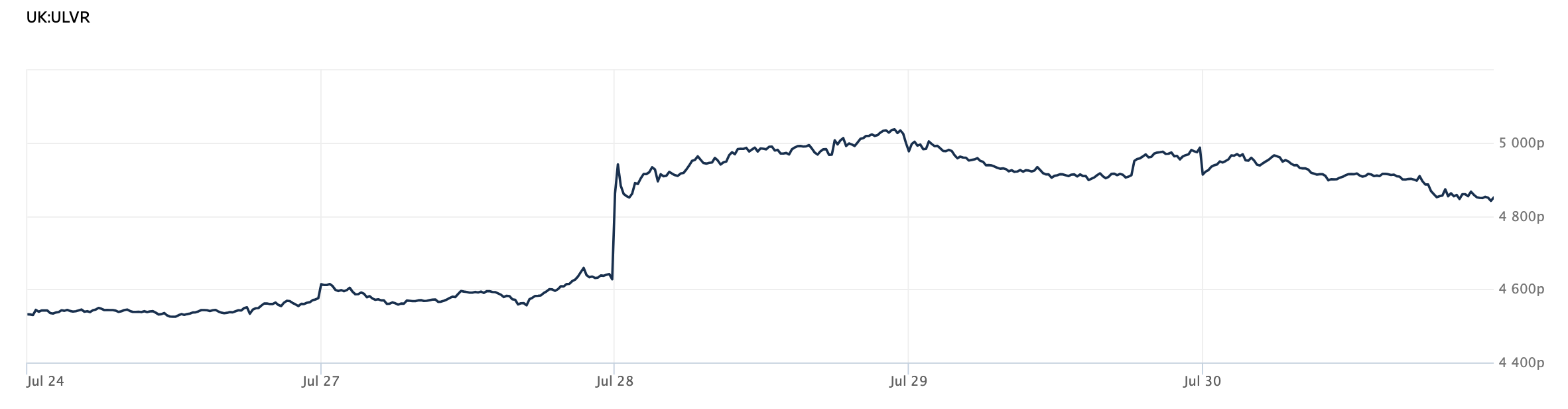
Good pop on earnings day
The stock is still off it’s Feb 1 high of this year and still off the April 2019 all-time high.
In a presentation and entitled “Desire at Scale Powering Strong H1 Performance” (What do you think about that title, BTW?) the company conveyed the following :
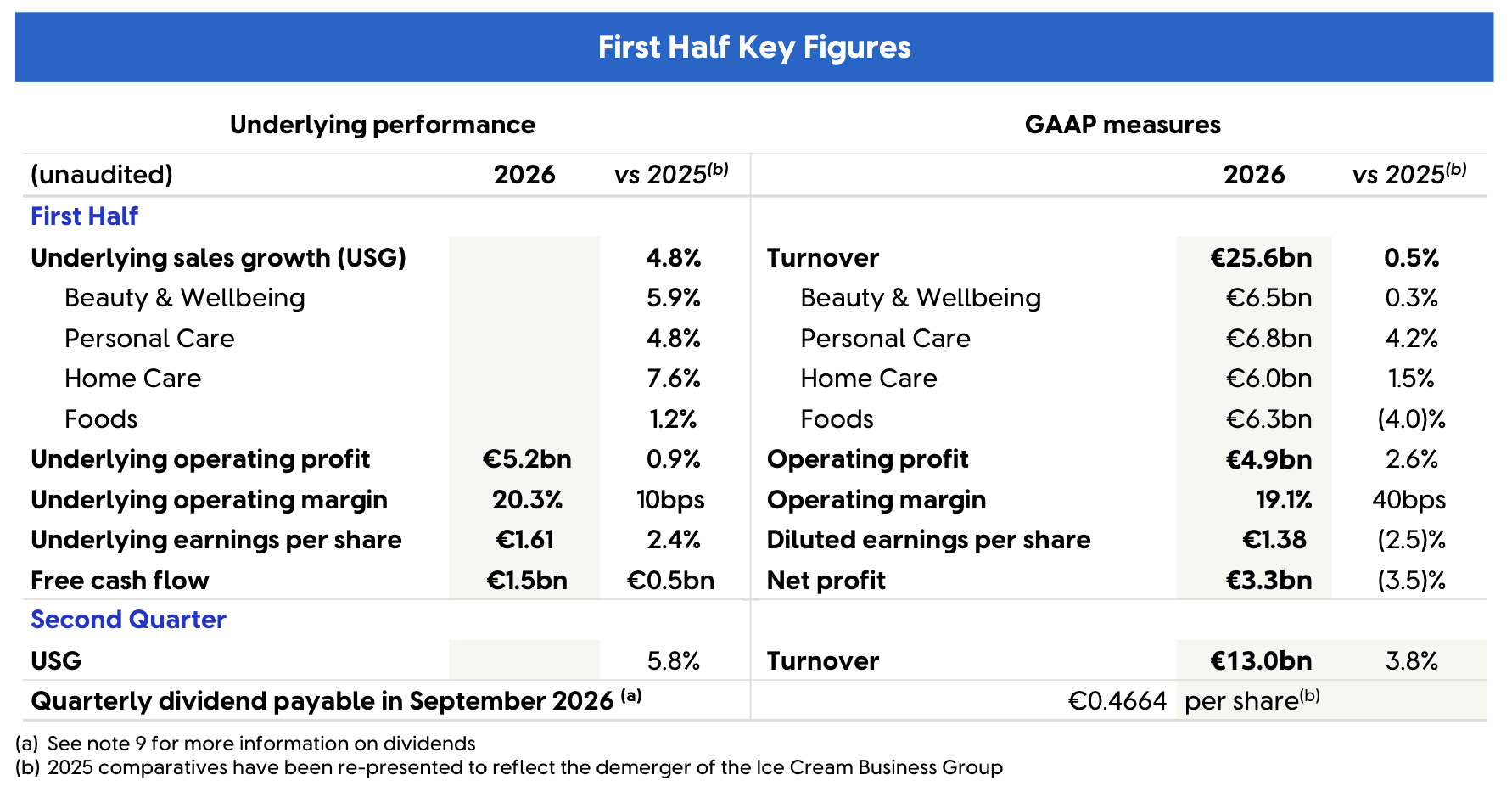
•While reported revenue eeked out just half a percent growth to €25.6bn for H1, Underlying Sales Growth (USG), after allowing for currency and such, came in at 4.8%, with 4.2% of that in underlying volume growth (UVG) and 0.6% price growth (UPG) (BTW – are you following these abbreviations?).
•They pointed to a Q2 acceleration with USG 5.8%, UVG 5.5%, UPG 0.2%; and boasted that was the best quarterly volume since 2010. (Hey – congrats UL!).
•Power Brands (78% of turnover): H1 USG 6.0% (UVG 5.4%); Q2 USG 6.9% (UVG 6.8%). 15 of 30 Power Brands grew double-digit in Q2.
•Underlying operating profit €5.2bn, +0.9%; UOM (Underlying Operating Margin) 20.3%, +10bps [a bp (basis point) is one hundredth of a percent or 0.01%. So 10 bps is 0.1%, so that means that H1 2025’s Operating Margin was 20.2%. I know you knew that. I just wanted to put it in here for folks that weren’t 100% (10,000 basis points) sure.].
In the business groups, I’m going to ignore Food because that’s getting spun off. (and when they say turnover, I’m changing it to revenue, because well, it just reads better to me.)
•Beauty & Wellbeing: revenue €6.5bn, USG 5.9% (UVG 4.5%, UPG 1.3%); UOM 19.5%, +10bps. Hair Care led at 9%; Skin Care low-single-digit; Wellbeing low-single-digit with Q2 improvement.
•Personal Care: revenue €6.8bn, USG 4.8% (UVG 4.1%, UPG 0.7%); UOM 22.2%, +10bps. Q2 UPG (0.9)% on FIFA promotions and prior-year comparators. US regained deodorant market leadership (wooh!).
•Home Care: revenue €6.0bn, USG 7.6% (UVG 7.4%, UPG 0.2%); UOM 15.8%, +30bps. Fastest-growing group; India reached record Home Care share. [That’s interesting right?]. Identified as the group with highest commodity-inflation and emerging-market exposure.[not surprising]
Emerging markets are 60% of sales, 40% developed markets. No big change there. In terms of an outlook, UL is loking at 4 – 5 % sales growth in the second half led by pricing. They attributed North America outperformance to multi-year portfolio shift toward Beauty & Wellbeing and Personal Care.
Raw materials and feedstock were discussed a fair bit as you might expect:
•They noted a commodity basket that they watch carefully, comprising: crude oil, vegetable oils, palm, SBO (soybean oil), packaging materials, "parts of LAB," and parts of energy cost. [which parts of LAB? I’m guessing n-paraffins]
•Inflation, the CY 2026 impact of which they estimate at €750–900m (€350 – 500m above last year’s planning), is concentrated in Home Care, with ~70% coming from emerging markets. The Iran conflict was cited as the culprit.
•Here’s an interesting one. Laundry powder was identified as the most-affected category by supply security issues; They stated 4–6 months of supply visibility there. However, UL’s Home Care Q2 business benefited from their "supply security and balance sheet strength relative to local competitors,". [Pays to be big, savvy and well-capitalized eh!]
•Commodity-driven pricing is expected to lead growth in H2 as it lands in market; H2 gross margin is guided to remain broadly at the H1 absolute level (~46.8%) despite higher inflation.
As always, I learned a bit from the Q&A:
•Dove grew ~9%, Vaseline double-digit %; Dove is ~40% of US Personal Care revenue. [Wow! right. These are mature brands to say the least. Growth like that, especially for Dove at a high sales rate already, is pretty good, right?]
•They talked a lot about the sell-in/sell-out gap and UL stressed many times, there was no gap. What does this mean? The concern is that if supermarkets (& others) are prebuying this quarter, more than they intend to, or can reasonably expect to, sell next quarter, then the growth UL is seeing in, say, Q2 has just been “borrowed” from Q3. So Q3 would then be much slower. So .. er.. Mind the Gap (sorry Londoners). CEO, Fernandez stressed that they have seen No Gap! And so I am duly re-stressing that point here.
So (and this my own editorial, not anything from the UL presentation), if you were a raw material supplier to UL (or a wannabe supplier), what do you make of all this? Here’s one thing. If you stuck around until the Q&A you heard UL’s CFO say that they watch the following: crude oil, vegetable oils, palm, SBO (soybean oil), packaging materials, "parts of LAB," and parts of energy cost. And, at the risk of being facetious, I’ll note that they are not watching these because their pricing and availability is extraordinarily stable and predictable… aaand their business is not that reliant on them anyway. These are pillars on which consumer products are built (all of them, not just UL’s) and they are volatile, VUCA, if you like (volatile, uncertain and all the rest of it). So, if you have a credible solution relating to one or more of this handful of commodities, you should go and talk about it. In fact, I’ll go one further. If you have some meeting (sales call, lunch whatever) scheduled and you don’t talk about one or more of these things in a problem-solving way, well that would be a wasted opportunity for everyone involved wouldn't it? (He just literally listed out the agenda for your meeting for you!). Don’t be the doofus who shows up and spends 20 minutes talking about the weather (unless it’s about El Nino’s effect on palm yields and what could be done about it). End of sermon.
By the way, I know P&G reported their FY’26 on July 29th. I’m going to cover that next month, if that’s OK?
Alright – back to more news:
I regularly opine on the sorry state of European industry and the tragic self-owns committed by governments and bureaucratic agencies in the matter. Jim Ratcliffe chairman of INEOS wrote a letter to the European Commission on this topic. You can read it here (https://www.ineos.com/news/ineos-group/letter-to-ursula-von-der-leyen/) . I’m cynical. I don't know Ursula Von der Leyen, president of the European Commission. Never met her. Wikipedia says she’s been in politics since the late 90’s and that “She lives with her family on a farm in Burgdorf near Hanover where they keep horses. She is a keen equestrian and has been involved in competitive horseriding.” Anyway, when Jim says at the opening of his letter “..you are aware that the chemical industry in Europe is highly stressed currently and is well into a ‘closure phase’. Approaching 200 chemical plants have closed down during the last five years.” And further that “It is clearly a ‘critical industry’ for national security purposes. Europe cannot run hospitals, feed people or build weapons without our key products.” He’s seems to be saying – here’s a couple of things that we can both agree on for starters. I’m not so sure that the members of the European bureaucratic leadership class, of which Ursula is one, do agree with these fundamentals.
Another letter was published this month by APAG and CESIO on the topic of EUDR. (Here: https://www.apag.org/wp-content/uploads/2026/07/260720-APAG-CESIO-statement-on-DA-amending-Annex-I.pdf ) It points out, once again, the ocean-tanker sized loophole in the regulations where “fatty alcohols used to manufacture surfactants are included in Annex I, whereas fatty alcohol ethoxylates and widely used surfactants remain outside the scope, despite being produced from the same feedstocks. This inconsistency weakens the coherence of the Regulation and will shift production outside the European Union without delivering environmental benefits.” Not mentioned, but looming over the discussion is the enormous overbuild of Chinese chemical (including surfactant) capacity highlighted in the INEOS letter. Actually, I kinda wish Jim had advised APAG/ CESIO on the drafting of their letter. Here’s what got me thinking though, the letter ends with “APAG and CESIO remain committed to working constructively with the EU Institutions…”. I don't doubt the sincerity of the two trade associations and believe their stated stance of constructive engagement is the absolutely correct one. What I find myself doubting is the existence of any commitment by EU institutions to work constructively with any element of the chemical industry.
Too cynical? Please convince me otherwise. I would like to be positive, if possible.
My well-thumbed copy of Beauty Independent caught my eye with the headine “Can Nude Miami be the Southeast’s answer to Erehwon?” Now, I became familiar with topless Miami during my last visit to South Beach for a conference, but this was something new. Apparently it’s a high end healthy grocery store. I quickly searched for anything surfactant-relevant, and here’s what I got. The article lists 3 brands, 2 bodywashes and a liquid handsoap, built on surfactants. The surfactant chassis (what’s the plural of chassis?) are as follows. Agent Nateur — holi (wash) Ageless Resurfacing Body Cleanser: sodium cocoamphoacetate, lauryl glucoside, sodium cocoyl glutamate, sodium lauryl glucose carboxylate. Clearstem — GENTLECLEAN: cocamidopropyl hydroxysultaine decyl glucoside and coco-glucoside, sodium cocoyl isethionate, disodium laureth sulfosuccinate, sodium lauryl sulfoacetate, sodium methyl cocoyl taurate, glyceryl oleate. Flamingo Estate — body washes and Castile hand soaps: potassium sunflowerseedate, potassium cocoate, potassium olivate, potassium castorate. So, no sulfates! That’s clear. APG/amino acid surfactant combos. SCI again. I’m not sure how significant this is. To me the store is for the monied virtue signaler. But, to the extent that influencers post their purchases here for followers to imitate, maybe it’s a data point for your trend analyses (that’s a plural).
[Editorial Team has not approved any images relevant to the above article]
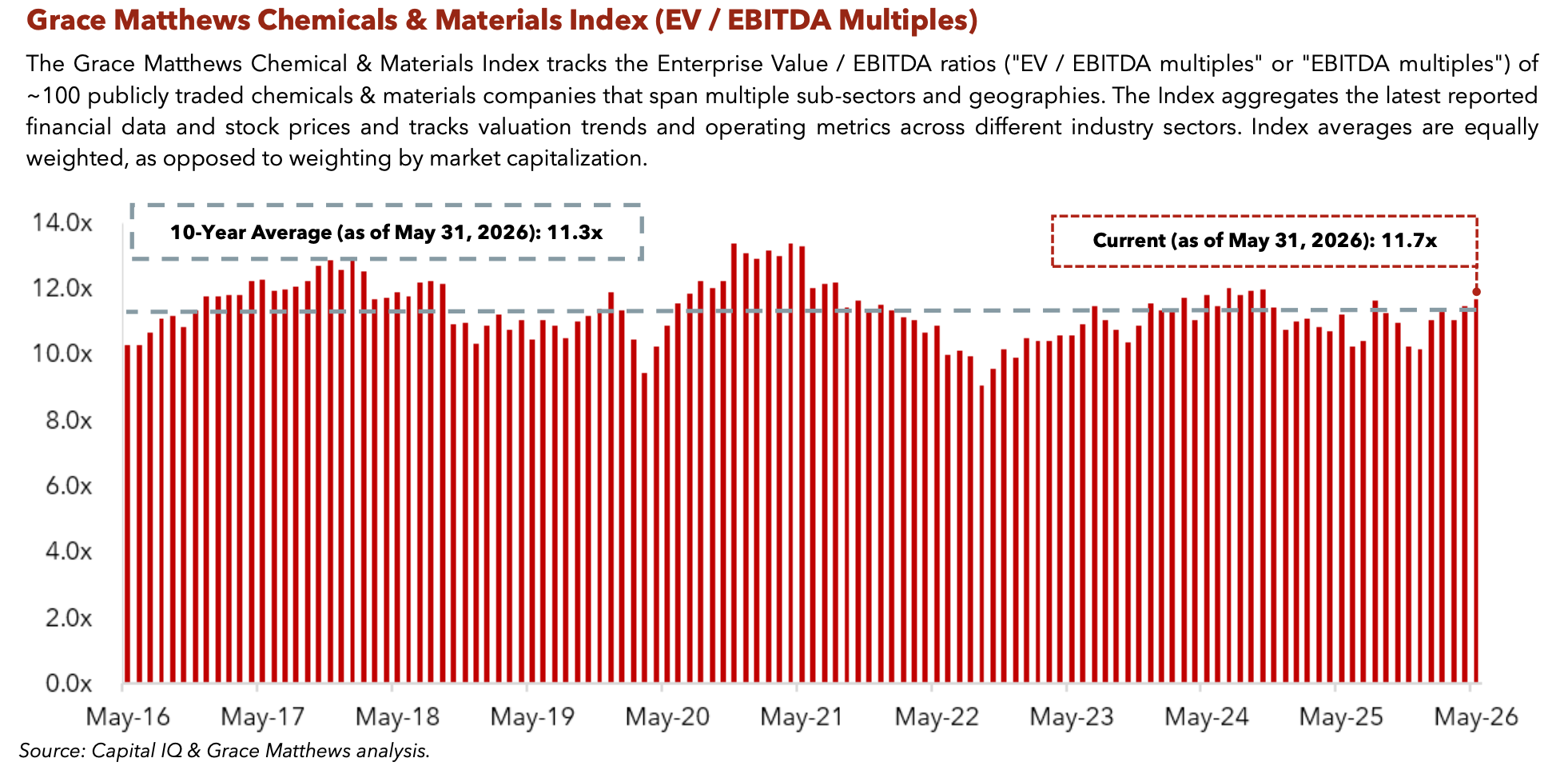
Investment bank, Grace Matthews just published their Summer 2026 letter. Read it here: https://gracematthews.com/newsletter-2026-summer/ (they talk about Clorox/Gojo and other interesting things). Here’s my favorite chart, stressing how, in comparison to many other sectors, chemical company stocks remain reasonably valued.
BASF sent me a press release about their Responsible Sourcing Report (2025). Gotta be honest with you. I didn't read the report, just the PR. It says, in part “In 2025, BASF was able to trace about 98 percent of its global palm (kernel) oil and palm derivative volumes back to the oil mill level; 79.2 percent of the palm (kernel) oil was sourced from RSPO-certified sources. Due to limited market availability, the target for full certification of palm-based intermediates has been adjusted to 2030.” Castor oil is also mentioned but no detail (again in the PR only). Can someone from BASF get in touch and let me know what the deal is with castor?
I read in HAPPI that AlEn USA (part of Grupo AIEn) has launched a new liquid laundry detergent in the US. Wot’s in there then? You ask. This (I left out the fragrances):
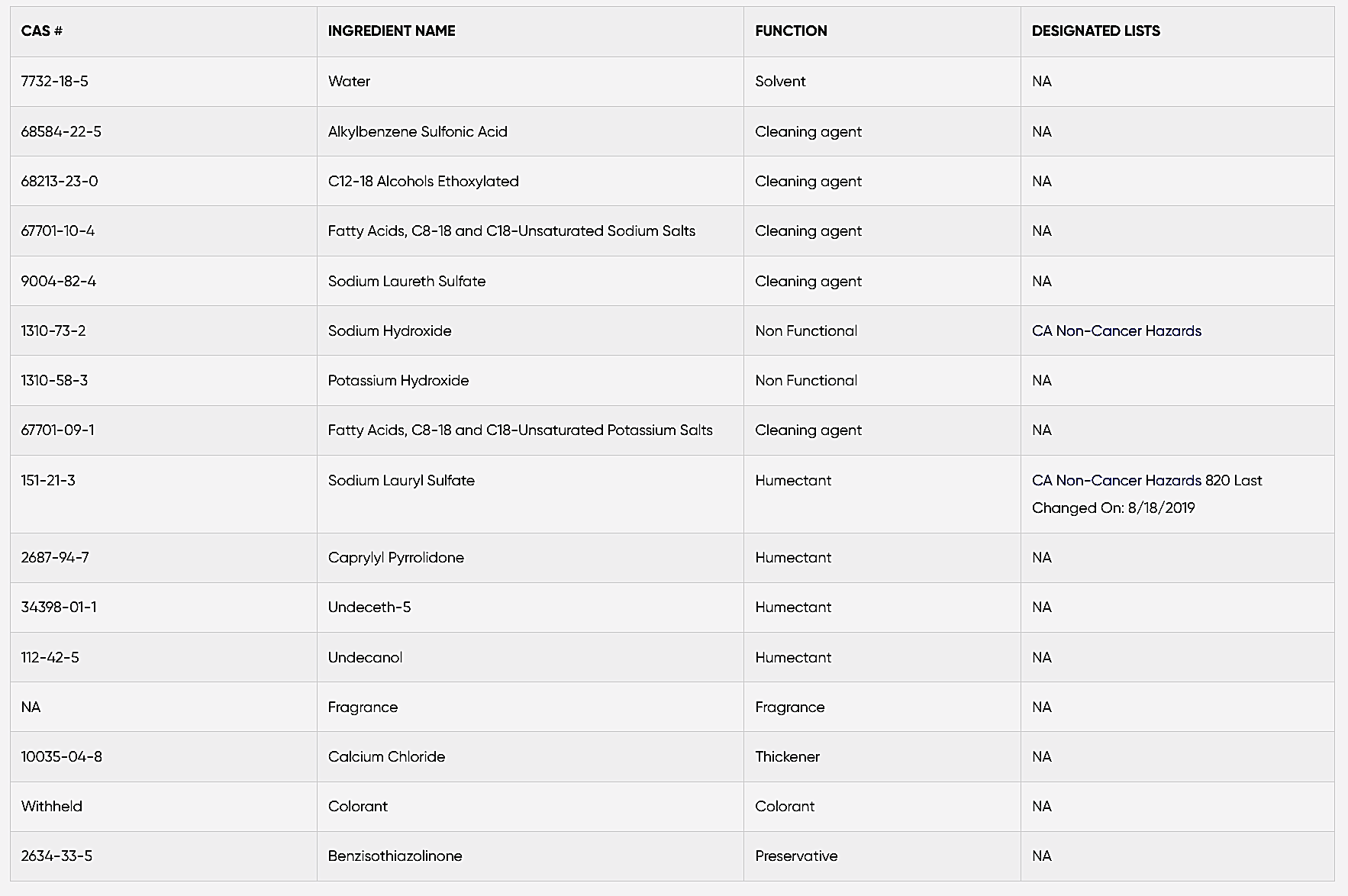
No surprises really but why is SLS termed a humectant? Don't think I’ve seen that before. Hey AlEn – get to the tipline if you can!

Drop a dime or a peso
HAPPI Top 50 is published. Here: https://www.happi.com/top-companies-reports/top-50-us-companies/ . Don't forget the International Top 30 which is on the tab right beside it, otherwise you’ll miss L’Oreal, Unilever, Henkel etc. New suppliers to HPC – it’s required reading.
Dr. Squatch has launched a kids line. This is the brand of Ms. Sweeney’s bathwater barsoap fame and the deployer of Megan Fox in double-entendre laced ads for stick deodorant. Do we need this? On a more serious note, I see many Linkedin posts decrying the marketing of beautycare products to children by all sorts of brands. I have to agree with the concern and I don't care what the ingredients are.
Fatty Acid Anti-Dumping Brouhaha. A kind reader sent me this https://www.trade.gov/commerce-preliminary-countervailing-duty-investigations-certain-fatty-acids-indonesia-and-malaysia . Here’s the money shot re the preliminary countervailing duties (CVD) determination.
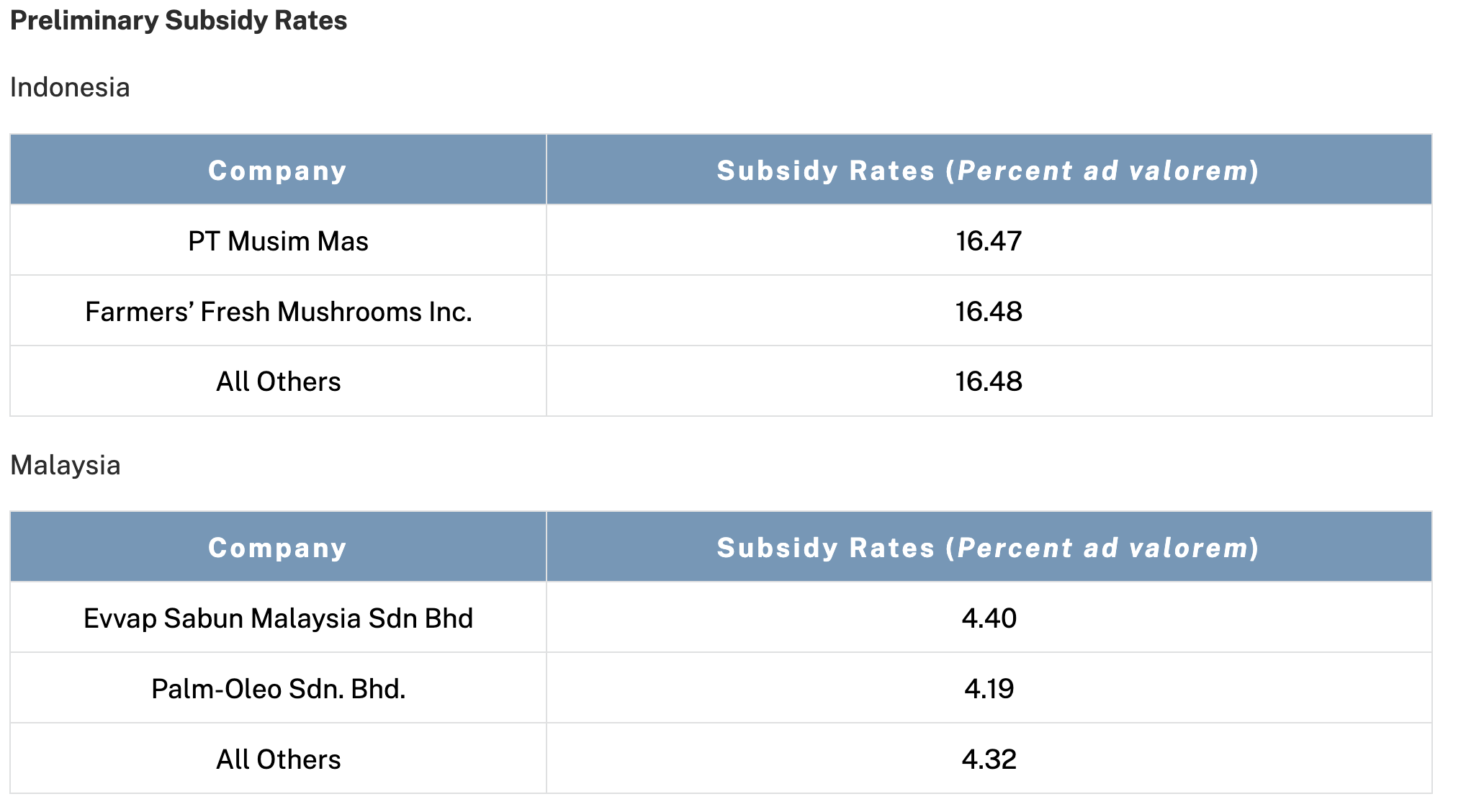
I’m really not following this now. How come Indonesia got relatively slammed vs Malaysia? More to come in November, apparently.
Right, I think we are more or less in the middle of blog so take a break if you need, glass of water, or something stronger. When you come back we have a guest article on MES from KLK (Malaysia). Note this is not paid article, it’s a guest article on a topic I think is interesting. No money has changed hands. If you’d like to write one get in touch.
Methyl Ester Sulphonate - From Alternative Surfactant to Mainstream Sustainable Solution
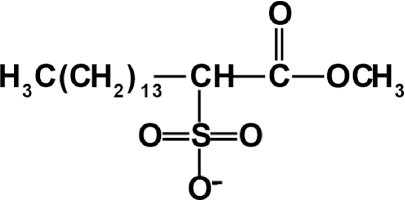
Molecular view of a C16 MES
1. Evolution of MES
10 Years Ago
- Viewed as an alternative surfactant
- Misunderstood as 1:1 replacement for SLES/LABSA
- Difficult formulation
- Limited commercial success
Today
- Primary surfactant system
- Proven formulation guides
- Better processing knowledge
- Widely used in Home Care & Personal Care
- Expanding into industrial applications
Why MES Has Gained Momentum
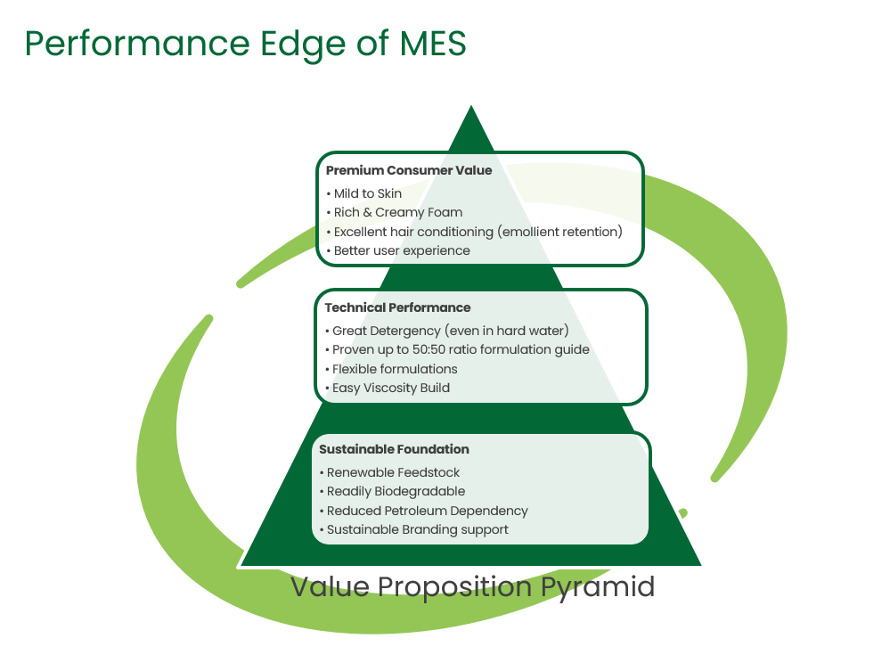
MES has evolved significantly over the past decade. Earlier adoption was hindered because many formulators attempted a direct one-to-one replacement of conventional surfactants such as SLES and LABSA. Today, formulation knowledge and processing techniques are well established. MES is now successfully incorporated as a primary surfactant in numerous cleaning and personal care formulations, offering an excellent balance between cleaning performance, mildness and sustainability.
Home Care Applications
Applications: Liquid Laundry Detergent, Dishwashing Liquid, Powder Laundry Detergent.
Advantages: Proven replacement up to 50:50, excellent detergency, rich foam, easier viscosity build-up due to C16–C18 chain, reduced NaCl requirement, renewable palm-based feedstock.
Personal Care Innovation
Applications: Conditioning Shampoo, Body Wash, Hand Wash, Sulphate Free Shampoo
Benefits: Mild to skin, gentle cleansing, improved emollient deposition, smoother hair, sulphate-free positioning, naturally derived ingredient. NMPA registration has increased interest in the China market.
Insights: Personal Care Formulation Guide:
A. Emollient-Enhanced Hair Shampoo
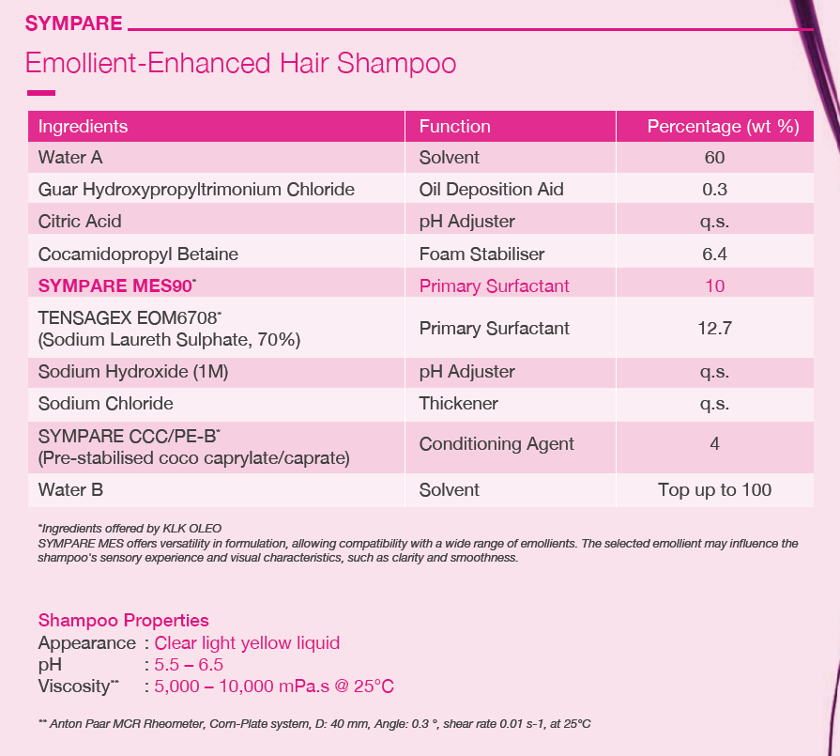
B. Foaming Hand Wash
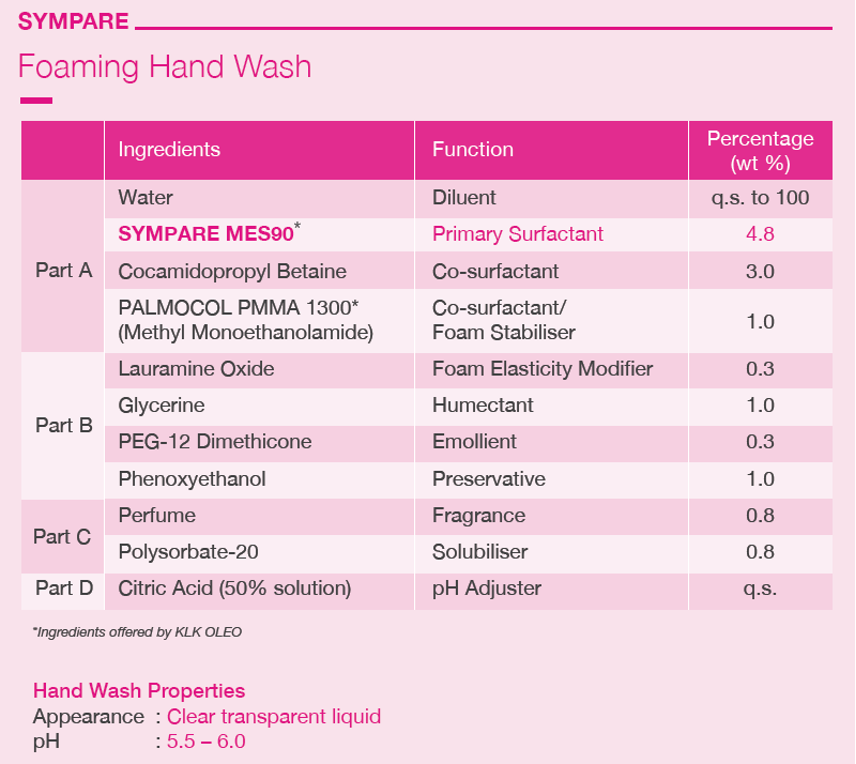
MES Options:
Home Care: MES powder for laundry powder detergent, MES flakes and low active 30% for liquid formulation
Personal Care: MES flakes and low active 30% for liquid formulation
Beyond Home & Personal Care
Pet care: Conditioning Pet shampoo
Wet Rubber: Anti-tack agent.
Enhanced Oil Recovery: Reduce interfacial tension.
Textile: Wetting agent.
Agrochemicals: Wetting and dispersing agent.
Conclusion
MES has transitioned from an alternative surfactant into a mainstream, sustainable surfactant platform with proven performance in home care, personal care and emerging industrial applications.
Back to the news: Talking about LAS, I found another example of companies marketing replacements for LAS due to the crazy recent price run-ups. In a Linkedin post, Catexel, which is the new name for Weylchem, touted SAS (Secondary Alkane Sulfonates) as such an alternative and I quote “WeylClean® SAS can often be used as a direct replacement for LAS. In many applications, switching from LAS to SAS is straightforward with minimal reformulation effort.” There’s more information on their site here https://www.catexel.com/product/WeylClean-SAS. Readers may remember this product was first (I’m pretty sure) marketed by Hoechst and involves the sulfoxidation of normal paraffins using UV light to initiate formation of free radicals from the paraffin. Upon further inquiry, I learned from the company that the product is available globally at a scale of several tens of thousands of MT/yr. Production continues to be at the former Hoechst plant in Wiesbaden, Germany. So I guess you’re eliminating dependence on the benzne but the n-paraffin from jet-kero is still there. Something to add to the roster.
On July 17th, Honeywell announced the completion of the deal (previously noted in the blog) to purchase Johnson Matthey’s catalyst business. This puts the company in an interesting position. As readers may know, Honeywell’s UOP makes and licenses catalyst and technology for the production of the vast majority (about 80%) of the world’s LAB. Johnson Matthey’s Davy makes and licenses technology and catalyst for the production of a large chunk (my guess is about two thirds) of the world’s oleochemical alcohol. Continuing our two pillars theme from earlier in the blog, you may well consider LAB and Detergent Range Alcohols to be the two pillars of the surfactant market. And now Honeywell to be a very large pillar holding up both. Something to think about. If I were a large user of such intermediates, well, I would make it my business to know as much as I could about Honeywell’s business.
And finally, in this section. Did you know we have a podcast in collaboration with the great HPC Today magazine? Episodes come every fortnight (2 weeks for readers outside the British Commonwealth) and are about 5 minutes long giving you concentrated doses of in-depth knowledge seasoned with just the right amount of opinion. Surfactants related, of course. Here’s a transcript of the soon to be released episode on Indovinya, so you get a sense of what it’s about. Available on very platform, including: https://open.spotify.com/show/1Ib3qlCtUjJjdEpMXq6krE?si=e65faac3dc3a4b6a , https://www.spreaker.com/podcast/surfactant-insights-podcast--6614902 and https://podcasts.apple.com/us/podcast/surfactant-insights-podcast/id1814104241
Indovinya – It’s Place in Surfactants
Indovinya is a relatively new company with some very important assets with a long history in surfactants. The name comes from Indo – which speaks to the company’s roots in Southeast Asia and Avinya which is a Sanskrit word meaning Innovation. Indovinya is the surfactants and downstream EO-derivatives segment of Indorama Ventures, a Thailand company. It is one of four segments of that company. The other three are CPET (a PET business) Indovida (a Packaging business) and Fibers. The company describes itself as the number 1 producer of nonionics in the Americas and the number 2 ethoxylation company, globally - In volume terms, and I believe that’s accurate.
The Indovinya product range is quite wide and includes Ethylene oxide (essentially all of which is used captively), ethylene glycols, ethoxylates and other nonionics, anionic surfactants and hydrotropes, ethanolamines, Fatty alcohols and acids, propylene glycol and PO, Linear Alkyl benzene, solvents and other specialty and biobased products, including sophorolipid biosurfactants.
Indovinya lists about 3,000 employees, 15 plants and 7 R&D centers. The footprint is very much Americas focused. In Brazil they have plants in Camacari, Tremembe, Triunfo and Maua. Mexico plants are in Coatzcoalcos and Guadalajara. There’s a plant in Montevideo Uruguay. In the US plants are in Texas – that’s Pasadena, Dayton, Port Neches and Chocolate Bayou. Elsewhere in the world they have office and or labs in India, Belgium, China, Argentina, Colombia and Australia. They sell products in all the application markets which you might expect. I’d say they have particular strengths in home and personal care and agricultural adjuvants.
A little bit about History. Indovinya has been built by acquisition. Starting in 2012 with Indorama’s acquisition of Old World’s EO and glycols assets in Texas, then in 2020 with the Huntsman’s EO and surfactants businesses in the US, India and Australia and then in 2022 with Oxiteno. More to come? Probably. Let’s see.
In terms of size, for financial year 2025, Indonvinya posted $2.44 Bn in Sales and $302 Million in EBITDA. A 12% EBITDA margin. This is down from 2024 which saw $2.47 Bn in sales and $346 Million EBITDA, that’s a 14% margin. Interestingly, as has been the historical practice at Oxiteno, Indovinya reports capacity, production and sales figures in metric tons. In 2025, production volumes were 1.2 Million MT vs a capacity of 2.14 Million, implying a utilization of 56%. In 2024 the figures were slightly better – production of 1.32 Million MT vs 2.07 Millon MT of capacity – implying 64% utilization. But really those utilization figures seem low. This may have something to do with production of EO for merchant sale. Apparently this business, which is mainly US based, is included in the CPET division. It is only captive EO that’s with Indovinya. Perhaps one of our knowledgeable listeners can get in touch on that point.
So – what’s the deal with the planned Initial Public Offering of Indovinya? Well, TLDR; It’s not happening this year. Here’s what I know. In March of ’24 Indorama Ventures carved the surfactants business out as a separate segment, named it Indovinya and said an IPO was under consideration for late ’25 or early ’26. A number of subsequent company statements around earnings reports and capital market days reaffirmed this plan. In July of ’25 Indonvinya raised a segment level $1.5 Billion term loan from a syndicate of 8 banks. This was interpreted by many analysts, including me, as preparation for the IPO. However on the 3rd Quarter 2025 earnings call, in November of that year, the company said the IPO was deferred and would not happen in 2026, given market conditions for industrial goods. They said it probably would occur in 2027 when they expect conditions to improve. So let’s see what happens. In the meantime, it is my impression that Indovinya is viewed as a growth asset in the parent IVL’s portfolio and I expect that they’ll continue to look at add-on acquisitions as they have in the past, that would increase the company’s attractiveness to public market investors. Such acquisitions could include those that expand the company’s reach further into markets outside the Americas, particularly the increasingly important Asia region. That is just my speculation of course, and again, we’ll see what happens.
I hope you’ve found this brief tour around Indovinya to be useful and thanks again, as always, for listening.
If this is interesting for you, please subscribe to the podcast.
Market News:
Asian spot prices for fatty alcohol ethoxylates trended downward, driven by falling mid-cut fatty alcohol feedstock costs and reduced consumer demand. Upstream palm kernel oil values in Indonesia and Malaysia softened following profit-taking and lower vegetable oil trends. Conversely, Chinese domestic ethoxylate prices rose due to higher local ethylene oxide feedstock costs, while Indian ethylene oxide prices face upward pressure from constrained domestic supply. Geopolitical tensions surrounding the United States and Iran continue to generate energy market volatility, dampening consumer confidence and spot buying interest across the region. Regional trade flows show increased petrochemical exports from China into Southeast Asia and India to offset conflict-related market gaps.
Global fatty alcohol markets.:
In Asia: spot offers for mid-cut fatty alcohols trended downward following a decline in feedstock palm kernel oil values across Indonesia and Malaysia, which also narrowed the regional price gap for the feedstock. Buyer interest in mid-cuts remained subdued as procurement for near-term delivery was completed. Conversely, long-chain fatty alcohol blends experienced increased demand and upward price movements driven by inventory restocking for the year-end festive season, while short-chain variants showed varied movement with gains in perfumery applications alongside weakness in downstream plasticizers. Broader market transactions remained limited to small lots due to ongoing geopolitical conflict in the Middle East and feedstock price volatility, though regional biodiesel mandates continue to support baseline palm oil demand.
In Europe: Mid-cut fatty alcohol spot prices continued an upward trajectory driven by prior increases in palm kernel oil feedstock costs and tight regional availability, while quarterly contract settlements trended downward as buyers shifted toward spot market transactions. Inland distribution across Europe faces logistical constraints due to low water levels on the River Rhine, which have strained rail and trucking transport alternatives. On the regulatory front, the European Commission expanded the scope of deforestation legislation to explicitly include palm-derived fatty alcohols, fatty acids, and soaps, while granting an extended compliance grace period for these oleochemical derivatives. Additionally, the Indonesian government delayed the implementation of planned natural resource export restrictions, providing policy relief to international markets reliant on palm oil exports.
In the USA: Fatty alcohol quarterly contract settlements generally trended upward, driven by higher feedstock costs for palm and lauric oils alongside tight availability for both natural and synthetic mid-cuts. In contrast, long-chain single-cut alcohol prices declined due to improved supply and sluggish demand. Elevated pricing and weak consumer sentiment continue to depress overall purchasing activity across downstream sectors. Upstream energy and chemical markets face ongoing volatility from Middle East geopolitical tensions, while a new universal tariff structure went into effect following a United States Supreme Court ruling.
The Asian linear alkyl benzene (LAB) Market: Spot prices initially increased, but purchasing momentum halted following a sharp decline in crude oil markets. Buyers across the region adopted a cautious wait-and-see stance, while linear alkylbenzene sulphonate suppliers attempted to push through higher price levels. Indian market activity remained stagnant due to seasonal monsoon conditions, whereas Chinese spot supply is expected to tighten owing to planned plant maintenance outages. Geopolitical developments in the Middle East and shipping security concerns continue to influence market sentiment, while corporate developments include an exit from the business by Argentina's YPF
In Asia's fatty acids: Spot prices for lauric and myristic acids experienced upward pressure due to elevated palm kernel oil feedstock costs, though buying interest decelerated as feedstock values began to ease. Demand for caprylic-capric binary acid increased due to downstream medium-chain triglyceride consumption and front-loading procurement ahead of the European Union Deforestation Regulation. Single-cut short-chain, palmitic, and oleic acid prices remained flat amid quiet market discussions, whereas rubber-grade and triple-pressed stearic acids displayed slight firmness. Overall spot purchasing across the region remained cautious due to ongoing Middle East geopolitical conflicts and energy price volatility, while regional biodiesel mandates continue to provide underlying support for crude palm oil demand
The Music Section
Do you know what redux means? It’s brought back restored or revived. I stumbled across a Jethro Tull song redux by The Well (who we’ve had the on blog before) on Spotify. It’s a whole genre and of course I went down the rabbit hole. Here’s some cool stuff I found.
First the aforementioned Well redux of Cross Eyed Mary
Black Sabbath has been reduxed a lot. Here’s a heavily faithful redux of Lord of this World by Howling Giant
I like these quite a bit. Here’s Green Lung’s version of Snowblind
And here’s Zakk Sabbath’s version of Under the Sun. By the way, I just love that riff that starts at 4:00 don't you?
By the other way, quick diversion, do you think Spizz listened to Under the Sun before recording this one?
OK back to the reduxes. Here’s a really very nice 15 minutes worth of Voodoo Chile as performed by All Them Witches. I think it suits them don't you?
Here’s another Hendrix. Gypsy Eyes by Wo Fat
That’s it!
When will I see you again? When will our ❤️❤️ beat together? October 27th – 28th in Kuala Lumpur of course https://events.icis.com/website/14105/home/