
Surfactants Monthly - AUGUST 2026
Commercial: Join me live in Kuala Lumpur for the 12th ICIS Asian Surfactants Conference (https://events.icis.com/website/14105/) , co-produced by me on October 27 – 28th, with the one day training on October 26th.
Hey by the way, if you read the blog after getting one of my monthly reminder emails, you are also already subscribed to the, still in beta phase, weekly surfactants news roundup email. It seems folks at least tolerate these as I haven’t had any unsubscribes. If you’d like to get on this list then put your details in here: https://www.neilaburns.com/subscribe Now, I want to be clear, before you head over there. By subscribing to this list, in addition to the monthly blog email, you will get a weekly surfactant news roundup email, containing 10 abstracts with links of mainly commercial surfactant related news. It will usually also contain my clearly labelled opinion related to surfactant relevant current events, which you can easily skip past if you just want the news snippets. All the recent opinions have been related to the Mid-East conflict. I commit to not selling (or giving away) your information (that would be sleazy) and I commit to only sending 1 (one) marketing email per year, which will continue to be usually in the Spring, telling you about the upcoming World Surfactants Conference which we hold each May in New Jersey. OK. There you are.
The News
Last month we mentioned that P&G (and Croda) had reported their results, but honestly we had just run out of steam writing so I held them over until this month. In the meantime, I put two videos up on our YouTube channel about these results. So let’s just link to those here along with links to download the very plain, mostly black & white, text-only summary slides with nary a single cute AI graphic on them. You’re welcome.
First Up P&G, where we talk about what’s growing, what’s not and the latest with that Tide Liquid Reformulation. (What? You hadn’t heard about that?! Well you’ll just have to watch the video - and make sure to read the important update below).
And the button below let’s you download the exceedingly boring slides.
Now: An important update on that Tide reformulation. Since the video went up, I have been talking to a number of people about it. It looks like the situation is not quite as clear-cut as it may seem. There are a number of versions of Tide Original out there on retailer shelves and there are several ingredient lists attached to these products. There is some disagreement between retailer ingredients lists and between the retailers and the ingredient listings on Smart Label. Smart Label is the third party service that P&G links to from their own site when referring people to ingredient information. Additionally I have heard some scepticism about the more prominent role of SLS in the new formulation as that may not be so good for cold-water performance. So - bottom line, the situation remains uncertain and more digging will be done. It may be that we are in a transition phase, but in the meantime, regard the remarks in the video as preliminary and expect to hear more in the coming weeks. By the way, it should go without saying that this is a big deal when the largest detergent brand re-orders the major active ingredients usage. That’s why we’re writing about it.
And then, Croda, where along with the results we see what’s happening with the transformation program, what the deal is with that rump industrials business and we wonder if a return to the glory days of Croda is indeed underway.
Boring slides button below.
I hope you downloaded both sets of slides because that’s all I’m writing here – trying to save some work for myself. Let me know your questions and comments on either company. The ever-open tip line remains…er… open.
Thinking about Tide?
You know Geno right? Used to be called Genomatica. Recently bought the old LS-9 (was REG for a while) technology for making fatty alcohols via fermentation of sugars with GM E. Choli bacteria (No affiliation with Jack-in-the-Box or Chipotle of which I’m aware. – yeah I know that’s a childish jibe but sometimes these things evade our censor – editor, I mean). Geno was the majority shareholder in a JV with Unilever, L’Oreal and Kao, to commercialize those fatty alcohols. Why “was”? Well, they’ve been acquired by a Danish company called Again (Nope me neither). From their website (https://again.bio/about/) it looks like Again is about computational biology to make products from waste CO2 and CO and from sugars (is that just the Geno bit?). There’s no actual products listed for sale on the site so I assume they are a technology company at the moment. Anyway they’ve got Geno and that lauryl alcohol now, so there’s something. Their website further says that “biology, not petrochemistry, should be the primary manufacturing technology of the future” and that they “are the AI-native biomanufacturing platform:..” and also that “The physical world runs on molecules. We're rewriting how they're made.” So, now you know.
But what about the financial terms of the deal? I hear you ask. Can we expect employees of Geno to be snapping up starter homes in Palo Alto for more than the price of some private islands (https://www.unhosted.ai/feed/6a80110c808ff2f0f8fd3425) ? Well, my guess is no. Terms of the deal were not disclosed. Coupla pieces of data that seem relevant. Again is a 5 year old company that has raised about $67 Million. Geno is 28 years old and has raised about $400 Million. Without any further information, that right there suggests to me that no-one except perhaps those at the very tippy top of the Geno preference stack got much out of it. Interestingly, I’m told that includes Lululemon. I hope to learn more as I still really like that alcohol technology. Anyway, if someone has more information, you know about our tipline right?

Collect calls accepted, even from Denmark
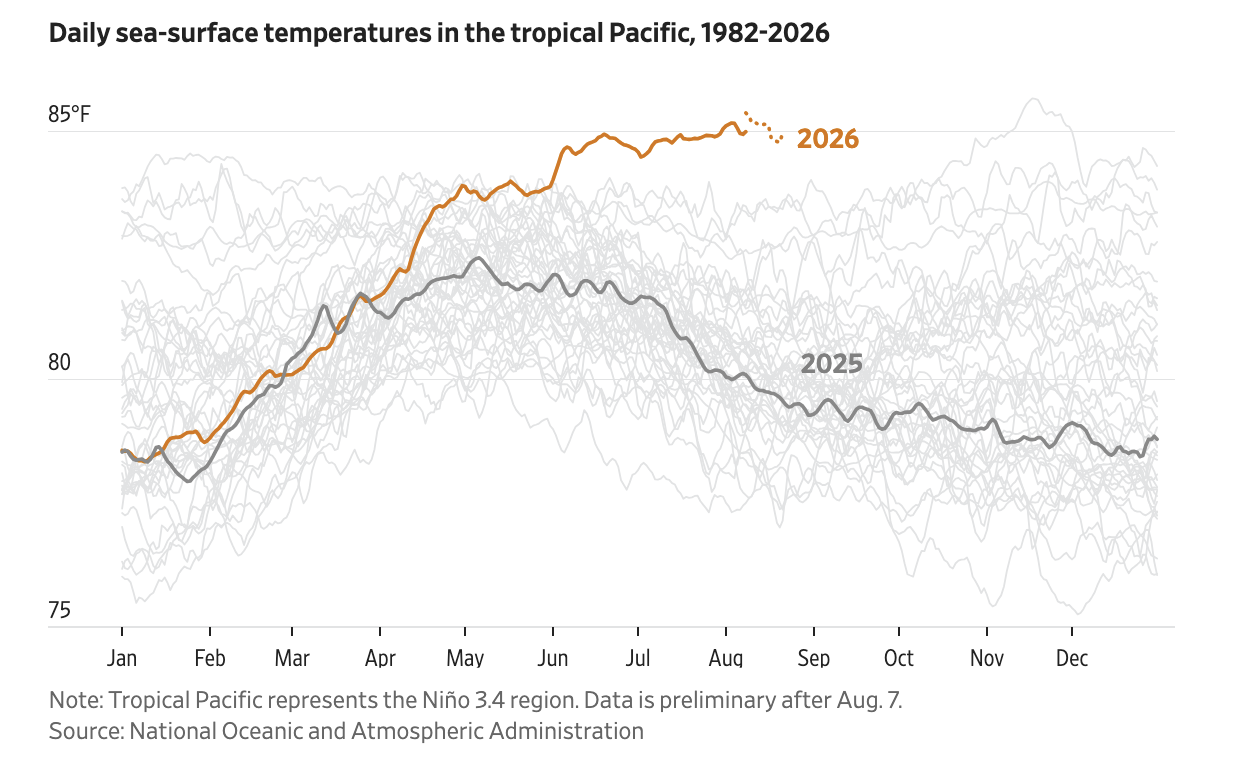
El Nino Watch: The WSJ had an interesting article here (https://www.wsj.com/economy/global/the-strongest-el-nino-in-a-generation-is-wreaking-havoc-on-global-economy) which says the 2026/27 El Nino is shaping up to be a doozy (In fact they call it the strongest in a generation, which I think counts as somewhat greater than a doozy) and considers its effects on the company Innovafeed. Who? you ask. If you’ve read the great Doris de Guzman’s Renewable Surfactants Report (https://www.neilaburns.com/reports) you’d know that the company is involved in black soldier fly larvae and products made therefrom, including, in partnership with Sasol, Surfactants. (https://chemicals.sasol.com/newsandevents/pressreleases/livinex-io-7). Now the WSJ article actually just talks about fishfood and how Innovafeed’s version is expected to do well because El Nino is crushing the anchovy catch in Peru (unlike you, apparently fish don't mind anchovies). Temperatures in tropical Pacific are already 5 degrees (Fahrenheit) above where they were last year.
Finally an informative image
But what does this mean for palm yields (and thus PKO and fatty alcohols and derivs)? TLDR; Nothing good. Here’s the current assessment out of Malaysia and Indonesia.
The Indonesian Meteorological office, BMKG has flagged Java, Bali, Nusa Tenggara, parts of southern Sumatra, southern Kalimantan, Sulawesi, and southern Papua for the most significant impact and below-normal rainfall over July–October 2026, and placed the peak of the dry season at August 2026. It names five priority provinces for elevated fire risk: Riau, West Kalimantan, Central Kalimantan, South Sumatra, and Jambi. A Malaysian analysis (MIDF) describes record rainfall deficits and prolonged droughts of six to eight months across all key oil palm growing regions in Southeast Asia, more intense in Indonesia than Malaysia, and comparable in strength to the 1997-1998 event. So it seems pretty severe.
The Malaysian Palm Oil Board (MPOB), (with whom, by the way, we partner once again for our conference in KL, October 27 - 28), says they expect a 2–4% year-on-year decline in Malaysia's total output for 2026 (on a 20.2 Million MT base), felt first in Q4 2026. MPOB also states that current CPO prices already factor in B50 and a strong El Niño, that the full production impact shows on a roughly 12-month lag, and that a secondary price spike is possible in 2027. GAPKI (Indonesia’s MPOB equivalent) chairman Eddy Martono's view is that a strong El Niño could cut Indonesian CPO output by up to 5 million tonnes, with the most significant impact felt as early as 2027. GAPKI producers expect approximately 53 million tonnes of CPO in 2026 (so a 10% drop – Wow!), and Martono states that domestic supply will be prioritized, with export volumes taking the decline. He could be talking the price up by taking the most pessimistic stance but, still. Given what we are seeing today and taking into account the time lagged effects fo the El Nino, it seems like we could be looking at a double digit percentage yield decline in 2026/27 which will squeeze both CPO and PKO markets.
What about coconut oil? Well, El Niño affects coconut flower growth, and that production takes approximately one year, and so the effect on total copra supply for milling shows up about 13 months after the conclusion of the drought. So the the current El Niño falls mainly on 2027 and into 2028 copra supply. In fact, according to the well-thumbed copy of the Manila Times lying on my desk, the PCA (Philippine Coconut Authority) forecasts higher production this year of 16 – 17 billion nuts vs 15.3 billion in 2025. I have to believe though (and this is just me) that 2027 and 28 will be hit. So plan accordingly. That’s all I can tell you. I’m not really a palm savant. Although we’ll have some folks that I consider to be real palm savants with us in KL, FYI.
Ok then, what else. Ah yes the Fatty Acid Anti-Dumping story. One of our great readers (You are all great! Really!) answered last month’s question about why Indonesia had been slapped with a higher counter-vailing duty determination by the US. They explain it as follows: “Indonesia has a subsidy fund that levies an export duty on palm Oil and Palm Kernal Oil. I believe that feeds into a fund that goes to biodiesel producers to subsidize their biodiesel production. Malaysia does not have such fund. Countervailing Duties are looking for ways that the host government unfairly subsidizes the home production. That is my guess on what Indonesia is higher.” Makes sense right? Keep the inputs coming!
Alpha Olefins. I know a lot of you continue to be interested in this feedstock for AOS and we’ve discussed the reasons for this in past blogs (not connected to palm, sulfate free etc.). ADI Analytics put out a press release here https://adi-analytics.com/2026/07/28/balancing-oversupply-and-resilience-in-laos/ about a multi-client study on Linear Alpha Olefins (LAOs). The PR itself is quite informative. It makes the point that some portions of the LAO distribution are now oversupplied, particularly at the heavy end (I think that means C16+ , but I’m not sure), due to capacity additions by Ineos and ExxonMobil. They also point out that on-purpose production technologies are gaining momentum, enabling manufacturers to selectively produce products such as 1-hexene and 1-octene without generating excess heavy fractions. Interesting right? If someone commercialized a process to make cost-effective on-purpose 1416 LAO, I think they’d see some interest, don’t you? I took a fresh look to see if anyone is in fact doing this and as far as I can see – no. No selective ethylene oligomerization beyond C8 is commercial. On-purpose 1-hexene (ethylene trimerization; Chevron Phillips since 2003 in Qatar, later Saudi Arabia and Texas; Axens AlphaHexol; Sasol) and on-purpose 1-octene (ethylene tetramerization; Sasol; Dow) are well established. Attempts to get selectivity for higher oligomers are still at laboratory-scale. If anyone knows any different, please let me know.
Interested in surfactants in agrochemicals? Check out this publication (https://app.box.com/s/p7j47ltqu6svj1rbeyhxmxol5jmrtetr ) by Agropages. I write a brief article in there on page 13.
If you’re in the cosmetics business, you should know that Illinois has published a list of 24 ingredients that the state now bans from inclusion in cosmetics. Here https://www.ilga.gov/Documents/Legislation/PublicActs/104/PDF/104-0545.pdf It inlcudes the usual rogues gallery of phthalates, parabens, formaldehyde and PFAS and others.
In last month’s blog I noted a responsible sourcing initiative for castor oil by BASF’s Care Chemicals business and asked for more information. The company obliged, which I appreciate very much. I’ll make a couple points here based on what they sent me. It’s an a effort underway for 10 years already with involvement by Arkema, Jayant Agro-Organics and the international civil society organization Solidaridad. BASF also helped establsh the Sustainable Castor Association (SCA) and the SuCCESS Code (Sustainable Castor Caring for Environment & Social Standards) [Kudos to whoever got to that acronym at BASF!], which BASF’s detailed report describes as the first independently auditable standard for sustainable castor production. So it’s serious and thorough. Whenever, usually small start-ups, in their marketing, criticize big chemical companies as being environmentally irresponsible… well, I find it irritating. Second. Today the Care Chemicals products covered by this raw material sourcing are a few emulsifiers Eumulgin® CO 40, Eumulgin® CO 60, Eumulgin® CO 410 and Eumulgin® CO 455, all based on hydrogenated castor oil chemistry (PEG-40 or PEG-60 Hydrogenated Castor Oil). In addition, Cetiol® SoftFeel is a SuCCESS-certified emollient based on a polymer containing sebacic acid (INCI: C12-18 Alkanoyl Glycerin/Sebacic Acid Copolymer). So, now I know and you do too.
Evonik. The great Craig Bettenhausen wrote another great article in the great C&E News, this time about Evonik’s fermentation plant for, among other things, biosurfactants. Here it is: https://cen.acs.org/business/biobased-chemicals/slovakia-fermentation-biobased-evonik/104/web/2026/08 I really want you to go and read it, so I’m not going to say much about it here. Just two things. 1) The plant does a lot of fermentation for many companies and products. Spreading bets, it seems. 2) We’ve often written here that separation and purification is a big challenge with biosurfactants. To the extent they have cracked that, Evonik wants to protect its trade secrets. So my favorite line of the story is after Craig gets basically all-area access on the site he was allowed to see the brand-new rhamnolipid purification plant only from the far side of the employee parking lot.(!)
You’ve probably read about low water levels in the Rhine affecting chemicals transportation. It’s serious. On August 5, 2026, the Kaub measurement station recorded a water depth of 19 centimeters, which limits river barge cargo loadings to under 20 percent of standard capacity. This constraint has disrupted raw material supply chains for chemical producers, resulting in force majeure declarations by operators including BASF, Lanxess, and LyondellBasell. Alternative freight options, namely rail and truck transport, are experiencing capacity constraints and cannot fully offset the reduction in river transport. Not great in an already super-stressed European chemicals market.
Connecticut is not all hedge funds and burnt pizza! An article in HAPPI notes that Unilever is partnering with Accenture to deploy AI-enabled digital twin technology across its global manufacturing network and has announced a $270 million investment to establish a research and innovation center in New Haven, Connecticut, scheduled to open in 2029. Concurrently, Henkel has broken ground on a $70 million Consumer Brands R&D campus in Trumbull, Connecticut, while maintaining its regional corporate offices in Rocky Hill and Stamford. Nice.
According to an article in the Indian Chemical Weekly BASF India has approved the closure of its sulphation and low-temperature reactor plants at the Dahej manufacturing site, under the company's Care Chemicals business. So that’s sulfation and ethoxylation, I’m assuming. The company cites increase competition and depressed margins.
For the classical formulator, thickening a surfactant system means adding salt. However, there’s salt-free thickening as outlined in a recent Colonial Chemical post here https://colonialchem.com/blog/blog/salt-free-thickening-a-slight-return/ . Worth a read.
Every so often folks send me commercial products in the market which contain their new ingredients. Here’s a couple I got recently:
BioRenuva’s Glycoplids – in Bubble Soft Launch Facial Cleanser
Integrity Biochem’s EdenSurf in Reve and Roots’ Seafoam Gel Cleanser
Send me more and I will publish but they have to be new – that is new products and relatively new consumer product launches.
In the European private label scene (you may well sell surfactants to these guys) McBride plc has entered into a five-to-eight-year strategic contract manufacturing agreement with Vestacy, under which McBride will acquire two manufacturing facilities located in Spain and Portugal for nominal consideration. Over the next two years, Vestacy will fund approximately £34 million (€40 million) in equipment across McBride's production network, while McBride will invest £17 million (€20 million) to cover transition, project, and capital expenditures. Production will be distributed across the two newly acquired Iberian sites and existing McBride facilities in Belgium, Poland, the UK, and France, targeting laundry and household categories to generate an estimated £170 million in annualized revenue by H2 FY28. The asset transfer is expected to close in early 2027, with full operational integration targeted for early 2028.
We don't usually do academic papers here but some folks at Colonial published an interesting one in the Journal of Surfactants and Detergents here: https://doi.org/10.1002/jsde.70093 . It essentially compares glycolipids to APG’s (and derivs). Some good detail in it.
Shell posted a cute ethoxylation animation on LI. Check it out if you’ve always wondered how this actually works on a molecular level.
Meanwhile, Shell’s US chemicals business remains for sale – if you’re interested. Probably not too late.
And finally, Unilever and Galaxy took over Linkedin (it seemed) for a few hours this month to talk about their collaboration. Very interesting and great see. More details here. Unilever and Galaxy Surfactants deepen partnership | Unilever. Key points. :
On August 19, 2026, Unilever and Galaxy Surfactants executed a Partnership Growth Charter to expand a 45-year commercial relationship.
• The agreement integrates Galaxy's surfactant engineering operations with Unilever's formulation processes to develop and commercialize new surfactant chemistries.
• The charter outlines three primary operational priorities: developing new product formulations, expanding supply chain capacity utilizing bio-based and lower-carbon technologies, and maintaining cost competitiveness through value-chain integration.
• Prior joint initiatives between the entities encompass the reformulation of Dove body wash, Lifebuoy soap bars, and the deployment of powder-to-liquid handwash formats.
• The two corporations are concurrently establishing shared manufacturing capacity in North America to reduce geographic distance to end markets.
Market News:
Asian spot prices for fatty alcohol ethoxylates remained flat due to strong buyer resistance against price increases, despite upward cost pressures from mid-cut fatty alcohol and ethylene oxide feedstocks. In contrast, domestic Chinese ethoxylate prices trended upward to reflect local feedstock cost increases. Purchasing sentiment across the region remains restrained, with market participants maintaining a wait-and-see stance amid volatile palm kernel oil values and energy supply disruptions linked to the expanding Middle East conflict. Upstream palm feedstock demand is supported by upcoming fatty alcohol production facility additions in Indonesia, along with anticipation surrounding European Union deforestation regulations and El Niño climate patterns
Global fatty alcohol markets.:
In Asia: Market demand and spot offers for mid-cut and long-chain fatty alcohols increased, driven by rising palm kernel oil feedstock costs and inventory restocking ahead of holiday seasons. Prices for certain short-chain variants rose due to limited spot availability, whereas single-cut and alternative short-chain prices remained flat. Anticipated supply reductions from the El Niño climate pattern and impending supply chain traceability mandates under the European Union Deforestation Regulation supported market sentiment and upstream demand. Concurrently, regional production faces constraints as Malaysian facilities schedule upcoming maintenance shutdowns and an Indonesian plant operates at reduced capacity following technical difficulties.
In Europe: Mid-cut fatty alcohol spot prices exhibited a stable to soft trend amid subdued purchasing activity, though upward cost pressures are emerging for forward deliveries due to rising palm kernel oil feedstock values. Feedstock demand is supported by Southeast Asian production capacity expansions, anticipated harvest declines from the El Niño weather pattern, and preparation for European Union Deforestation Regulation mandates. Regional waterway transport experienced slight improvement as rising River Rhine levels enabled increased barge loading, following earlier operational disruptions including a declared force majeure on surfactant production by BASF. Key regulatory developments include the European Union expanding deforestation rules to encompass palm-derived oleochemicals under an extended grace period, alongside a postponement of planned Indonesian export restrictions
In the USA: Upcoming contract negotiations are beginning amid rebounding palm kernel and coconut oil feedstock costs, which have reached recent highs due to supply concerns. Spot availability for mid-cut and specific long-chain blends remains tight, while supplies of longer-chain variants are ample due to weak downstream demand. Upstream lauric oil prices initially fell following the outbreak of conflict between the United States and Iran, but values are currently recovering amid fears regarding El Niño weather impacts, heightened biofuel consumption, and European inventory building ahead of deforestation regulations. In regulatory news, specific exemptions for fatty alcohols and related feedstocks from newly implemented forced labor tariffs have mitigated cost pressures, although overall import expenses are expected to remain elevated. Furthermore, ongoing diplomatic negotiations between Oman and Iran regarding the Strait of Hormuz continue to generate uncertainty in global energy markets.
The Asian linear alkyl benzene (LAB) Market: Spot markets stabilized as purchasing interest eased following a retreat in upstream crude oil values, shifting regional buyers into a wait-and-see stance. Upstream feedstocks including jet kerosene and benzene lost upward momentum, though suppliers held offers steady due to tight availability from Chinese plant maintenance and persistent Red Sea shipping disruptions. Indian import activity remained sluggish under monsoon conditions, even as domestic spot prices saw an uptick from local inventory replenishment. Linear alkylbenzene sulphonate markets similarly encountered weakening buying momentum and softening regional offers. In corporate developments, Argentina's YPF completed its exit from the business to focus on its energy core, while multiple Chinese producers scheduled or carried out facility maintenance turnarounds.
In Asia's fatty acids : Spot offers across most fatty acid grades trended upward due to rising feedstock costs across the upstream palm oil complex, including crude palm oil, palm kernel oil, and palm stearin. Lauric, palmitic, oleic, and stearic acid prices increased under cost pressure, with oleic acid additionally supported by pre-loading shipments to Europe ahead of deforestation regulations. In contrast, short-chain and myristic acid valuations remained stable. Overall spot purchasing activity remained cautious amid regional feedstock price disparities, though market sentiment is supported by anticipated inventory replenishment, downstream fatty alcohol capacity additions, and projected upstream yield reductions linked to the El Niño weather pattern.
The Music Section
In the 1970’s, I think it’s fair to say that all young boys (most, for sure) looked to Clint Eastwood as the laconic model of manhood. He didn't say much, but what he did he meant. It was those spaghetti westerns. I remember this line in particular which I used in a conference talk some years ago, commenting on certain market dynamics at the time when the power was in the hands of the buyers.
But it was also the music. Rember this one? Has ever music been used to such effect in a film?
So I have to credit this month’s music section to an unforeseen collaboration between the algorithms of Spotify and YouTube. There’s a great channel on YouTube called Underrated Albums, music from which we’ve had in the blog before. But it was Spotify that suggested to me their collection called Music Inspired by Spaghetti Westerns. This stuff is really great – especially if you are of a certain age.
Here are some highlights.
Actually first, here’s the whole thing. It’s only 5 hours so….,
Ok so now some highlights from the original artist music videos contained in the above collection
Santiago’s Theme by Federale (great trumpet)
And theme of the gunfighters
Vern Jules (geddit) and the Aquanauts – Clint
Spindrift – speak to the wind
A rather understated Wyldewood by the Hang 10 gallon hats.
I like the organ on this. Hunting Party by Dark Canyon
I have to leave you with this one. Tumbleweed Bong Rip by Dead Luke
That’s it!
When will I see you again? October 27th – 28th in Kuala Lumpur of course https://events.icis.com/website/14105/home/
Our hearts will beat together!