
Surfactants Monthly – September 2026
I’m told FOMO is a powerful motivator: So.. er.. don’t miss out! Join me in Kuala Lumpur for the 12th ICIS Asian Surfactants Conference (https://events.icis.com/website/14105/), co-produced by me on October 27 – 28th, with the, almost sold out, one day training course on October 26th.
End of commercial.
Hey, we have guest article this month from Libra Specialty Chemicals. It’s a very informative piece on how to approach Greenhouse Gas (GHG) and PCF measurement for a mid-sized chemical company. You’ll see it at the end before the music section.
The News:
We talked last month (and in the video before that) about the Tide Liquid reformulation and the fall of LAB and rise of Alcohols therein. More information has come to light and so I’m just going to keep writing about it here and eventually someone from P&G will write in and clarify what the whole deal is, maybe.
I went to my friendly neighbourhood, Aldi here in Freehold NJ (they are actually friendly BTW and the prices are great!) and I spotted this orange and yellow fellow in the wild.
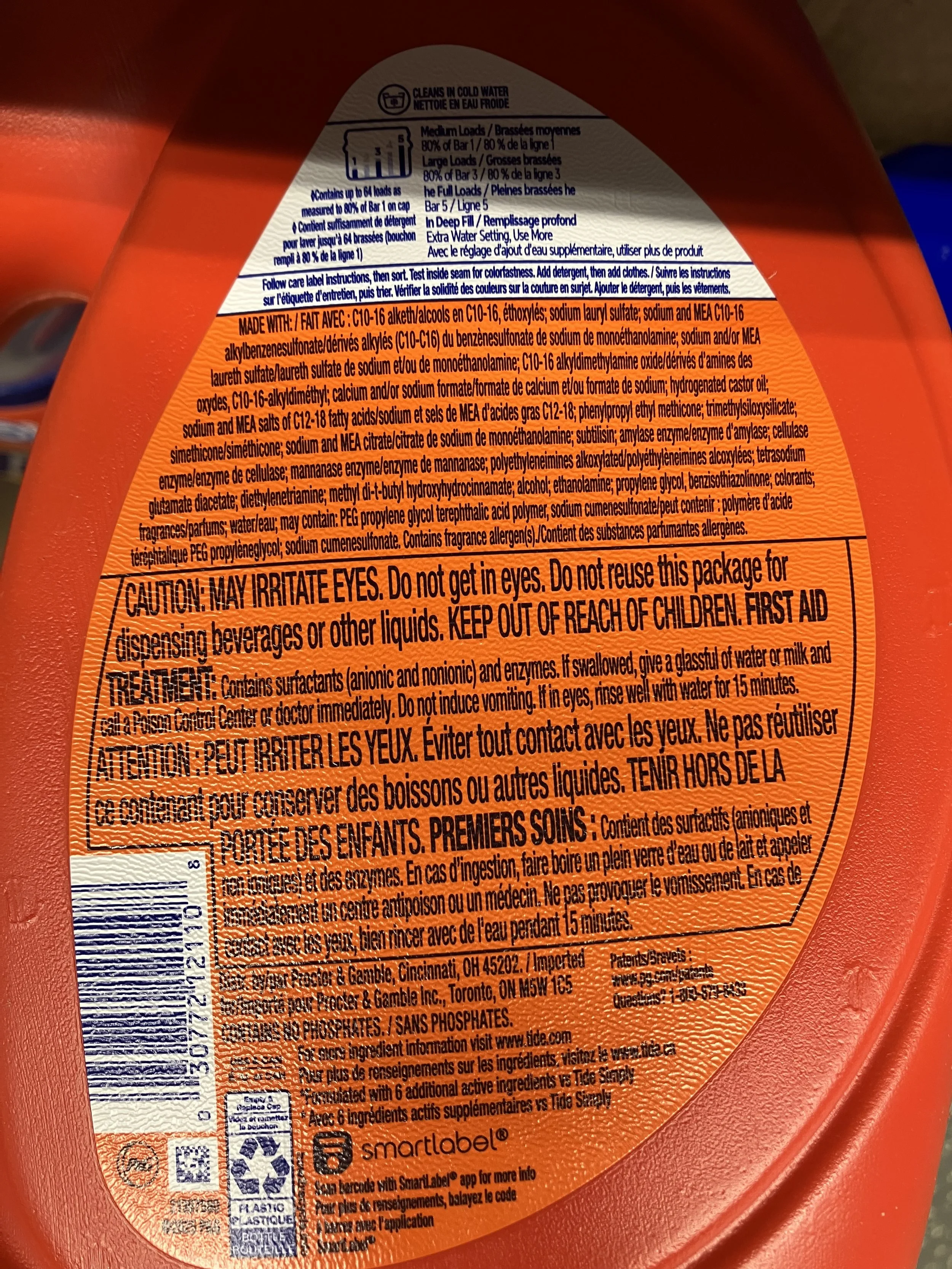
Gotcha!
It’s an 80 oz, 64 load bottle of Tide “Boosted”. The first 5 ingredients, as you can see, are :
· C10 – 16 Alketh
· Sodium Lauryl Sulfate
· Sodium and MEA C10 – 16 Alkylbenzenesulfonate
· Sodium and/or MEA Laureth Sulfate
· C10- 16 alkyldimethylamine oxide
OK – got that? Now, we’re going to take the product barcode (30772121108) (see it on the bottom left?) and go over to Smartlabel, where P&G directs us to get ingredient information on their products. The page for this same product number is here https://smartlabel.pg.com/en-us/00030772121108.html . It lists the first 5 ingredients (after water) as follows:
· C10-16 Alketh
· Sodium and MEA C10-16 Alkylbenzenesulfonate
· Polyethyleneimines alkoxylated
· Sodium and MEA Laureth Sulfate
· Sodium Lauryl Sulfate
Interesting right? Different order. Couple of comments. The “Polyethyleneimines alkoxylated” shows up on the bottle eventually, down after the mannanase enzyme. The amine oxide shows up on Smartlabel at #7. You can do your own analysis and see what else you can find out. To me it looks like the ingredients are the same but in a different order. So..
So, I’ve been talking with someone who does this for a living (studies detergents, among other things), not like me, the rank amateur. They made me aware of the California Cleaning Product Right to Know law(s) which governs labelling of detergent (and has become a de facto national standard). So I had my assistant, Claude, look at them. After briefly threatening to wipe me out, along with the rest of humanity, he told me the following: The manufacturer should name the ingredients with the HCPA dictionary or INCI name (or IUPAC, common name etc. if first two aren’t available) with an option to exclude confidential business information. Regarding the order of the listing of the ingredients, the law only stipulates this with respect to an online listing (e.g. Smartlabel or companies own site etc. ) and says “shall be listed in descending order of predominance by weight in the product, except that ingredients present at a weight below one percent may be listed following the other ingredients without respect to the order of predominance by weight.” A strict reading of the law, then, says that the order of ingredients on the bottle does not necessarily have to be in weight order, but the Smartlabel listing does have to be. Got that?
My correspondent has expressed some skepticism about the prominent position of SLS on the bottle listing. Fine. But then the bottle listing does not have to be in weight order, apparently. They also point out that, on Smartlabel the polyethyleneimine alkoxylates have a “CAS # withheld” in there. Maybe this means that this anti-redeposition ingredient is part of confidential business information and therefore not subject to the CA law and therefore – maybe – it’s position in the online listing is not actually reflective of its weight percent presence. Wow! So, potentially, neither listing is actually physically, reflecting weight order, although both, I hasten to add, I’m assuming are legal. Am I overthinking this? Are there some dark labelling arts at play?
One more thing to point out. There are many product codes for Tide on Smartlabel, some with LAS still in the #1 position and others with the nonionic. And the ingredient listings on the retailer sites also are all over the map. And I also think it makes sense that the rollout of new product formulations would not be instantaneous, right? There’ll be more to write on this next month, I’m sure. In the meantime, I think it’s only appropriate to remind you all of the existence of our tip line.

All non-confidential inputs gratefully accepted
By the way in related but much less interesting (to me) Tide news, I read in HAPPI that: For the first time in more than 30 years, P&G has expanded the Tide Free & Gentle portfolio. New Fresh & Gentle with Coastal Oasis Scent marks the first dermatologist-tested scented product addition to the line up intentionally created for consumers who no longer want to choose between gentleness, scent and cleaning performance. Hmm OK, but actually this does remind me that the fragrance / surfactant interface is an important one and so your periodic conversations as a surfactant manufacturer should also include a fragrance company or two.
Now I know that some of you think the tip line is an inside joke and a bit of cover to justify the inclusion in the blog of humorous and entertaining imagery that would not otherwise pass editorial muster at a serious business publication. Well, two things can be true at the same time. People use it. Last month someone let me know, via the tip line, that Chevron is talking about surfactants on their earnings calls. I checked it out and they are, and that shouldn't be surprising, given the price of oil. Over the past decades, we’ve seen that, as oil approaches $100 a barrel. EOR (Enhanced Oil Recovery) and other types of secondary and tertiary recover (is there a quaternary recovery yet?) get a boost and pull in the consumption of various surfactants, existing ones like LAS and such and also more customized things like various structures of IOS (internal olefin sulfonates). Even pilot trials can use thousands of MT per year of surfactants and the large oil companies like Chevron, Shell etc. have programs around such surfactants alongside companies like Stepan and Nouryon. In fact EOR mentions pop up on Stepan’s filings from time to time. At Chevron’s investor day, the company talked about applying EOR chemical cocktails to all their Permian basin wells. They said that much of what they’re doing is using proprietary surfactants from their company Chevron Oronite. On their 2025 earnings call, they elaborated further (quoting): “We've been primarily focused on the Permian, and in fact, we've increased the treatments from about 40% of the new wells being treated at the first half of 2025, to almost 85% will be treated this year and we're striving to hit 100% in 2027. It has been more of a focus in the Permian. And I’d just point out we're testing our proprietary chemical technology, but we're also testing the combination of that with other commercially available chemicals, cocktails as such. We're trying out different things depending on the development area. We showed at Investor Day some of our results. We're now realizing 20% improvement in 10-month cumulative recovery on the new wells.” OK, so now you know. If you’re a surfactant company, you probably should be talking to the oil majors. Yes, that includes you biosurfactant guys (see next paragraph)!
More on oil. My attention was drawn (yes also via the tip line) to the LA Times article on August 27 about Shale Oil drillers using surfactants to get as much as a 20% boost in recovery with minimal additional cost. There are some different companies in this space. Ovintiv was mentioned. And Diamondback Energy and Permian Resources. Also – here’s an interesting stat. According to a consultant, Out of an average $8 million total cost to drill and frack a shale well in the Permian, operators will spend about $200,000 on surfactants. So that’s 2.5% of drilling cost (check the math – it’s not a lot right?). Now, the same consultant (Spears Associates) says in a Bloomberg article that demand for surfactants in US oil fields is expected to grow 29% by 2030 to 313 million gallons sold. The firm projects that oil and gas operators around the world will spend $1.7 billion on surfactants this year, with almost three-quarters of that outlay coming from the US, the largest market. OK so let’s just do a bit of math on these numbers. If a gallon weighs about 3.8Kg, then that’s about 1.2 Million MT of surfactants. However, the fact they’re talking gallons means they’re not talking active matter. If we assume that those gallons are about 40% active, then that’s 475,000 MT/yr active surfactants. That seems about right to me, maybe even a touch low. Dollar-wise, I had the market at $1.5 Bn but I’m not quibbling over $200K in today’s crazy price environment.
There’s more. Almost 10% of all new frack jobs are using surfactants, according to Select Water Solutions Inc., which has developed 26 new surfactant formulas for just one customer. Locus shows up in article also. Good for them. (BTW I might have to take back some of what I said about the LA Times in times past.)

What’s your oilfield strategy?
In response to my appeal last month, someone dropped a dime (non-US readers, please google that phrase) on the Again / Geno deal. Apparently (Danish Co.) Again made small quantities of acetic acid in the US from carbon monoxide at the Dow TX City plant, and appointed HELM as agent for the business. They also talked about some other acetyl derivatives. Interestingly HELM and Cargill are in the QUORA JV for the 1,4 BIO BDO license ex Geno. Geno licensed BIO 1,4 BDO also to BASF, Kureha, Novamont and at least one other company., Focus there was more on the NYLON chain - adipic acid, HMDA, Polyamide, 1,4 BDO. Geno also had a humectant from sugars product, 1,3 butylene glycol business. After the invasion of Ukraine and the energy crisis in the EU, it was not feasible to campaign 1,3 BG in the Novamont 1,4 BDO unit. And so, they exited the 1,3 BG sales business. Aren’t our readers great?!
Everything’s correlated with everything else. That’s a bit of an exaggeration but the days when various vegetable oils and vege vs petro could be used to hedge each other, are long gone. Bloomberg recently reported that soybean futures have hit their highest level since 2023 due to increased use of soybean oil in biodiesel due to EPA subsidies. Don't forget the same dynamic supporting palm prices in SEA, particularly Indonesia.
I read that Dow is considering the sale of its 35% stake in Sadara, their JV with Saudi Aramco in the KSA. Established in 2011, Sadara operates 26 manufacturing units capable of producing more than 3 million metric tons of chemicals and plastics annually, including surfactants (alkoxylates in particular). My sense (based on no other information) is that Aramco is the likeliest buyer. However, I would certainly be open to a call on the tipline about this.
Speaking of divestitures, Reuters reports that Colgate is looking sell a bunch of personal care brands, worth up to $1 Billion. Colgate's personal care unit includes deodorants, bar and liquid soaps, shower gels, and skin care products. It currently only plans to divest a few brands in the unit. The biggies are Softsoap, Irish Spring and Speed Stick. Goldman is working on the deal. So there you go. If any of you new biosurfactant guys are frustrated with the slow pace of sales development, just buy Softsoap and put your stuff right in there. Boom. Done! That’s not serious investment advice, by the way, although strategies like this are considered.
Speaking of this strategy, Holiferm announced that they merged with Organica, a UK company that makes consumer laundry and cleaning products. I couldn't see any financial details, so can’t conclude if one bought the other or it was merger of equals, or something else. Nonetheless,I expect the idea is market access for Holiferm, enabling them to get ingredients in products on the shelf, whenever they like. THe full press release is here. https://holiferm.com/powering-the-future-of-sustainable-chemistry-holiferm-organica-uk-join-forces/
Toward the beginning of the month, HAPPI wrote one of their periodic features on surfactants. Check it out. It’s worth a read. No-water, low-water, sulfate-free etc. It’s all there. They even discuss the Tide reformulation. Coast Southwest and Pilot get a lot of airtime in the article. Interesting to read what they are doing.
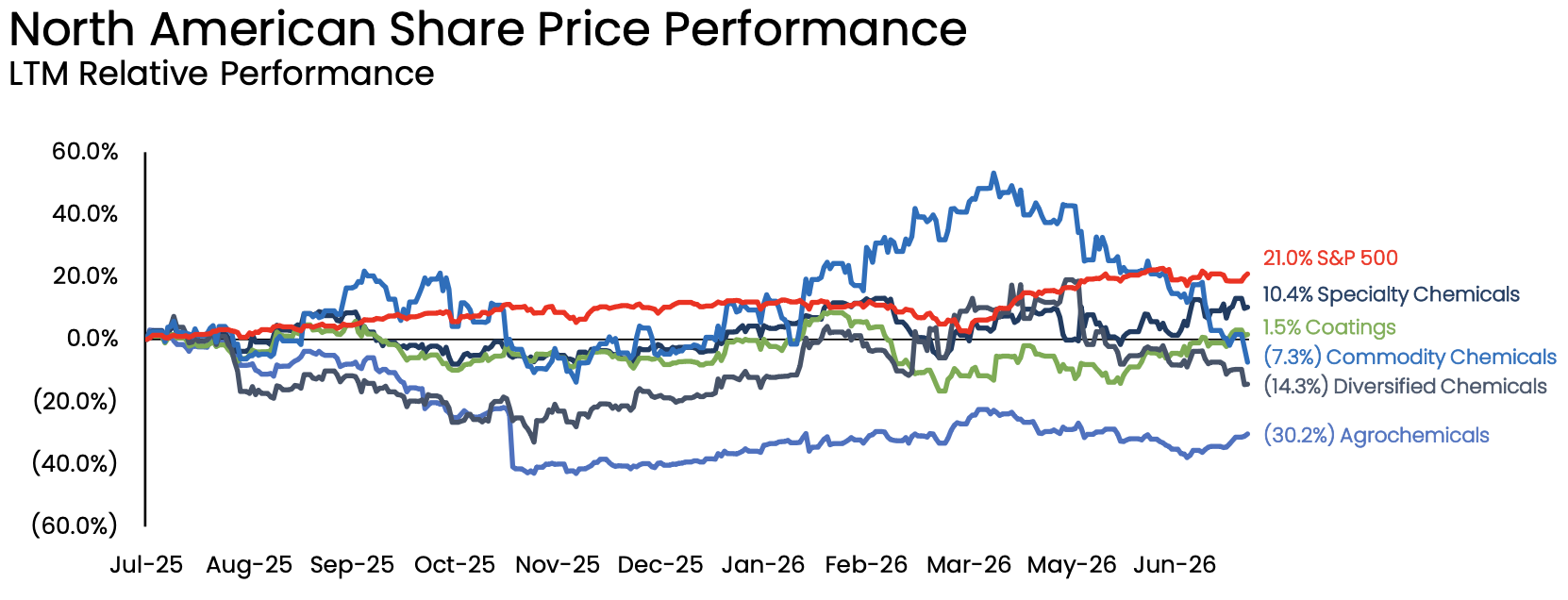
The great Balmoral Advisors investment bank published their Q2 2026 newsletter this month. You can download it on their website. First up here’s a couple of fascinating graphs. #1 – Every single segment of US chemicals has underperformed the S&P 500.
#2 After a couple of months flying too close to the sun, you can now pick up a US commodity for 6X. (I know some of these data sets are small but still..)
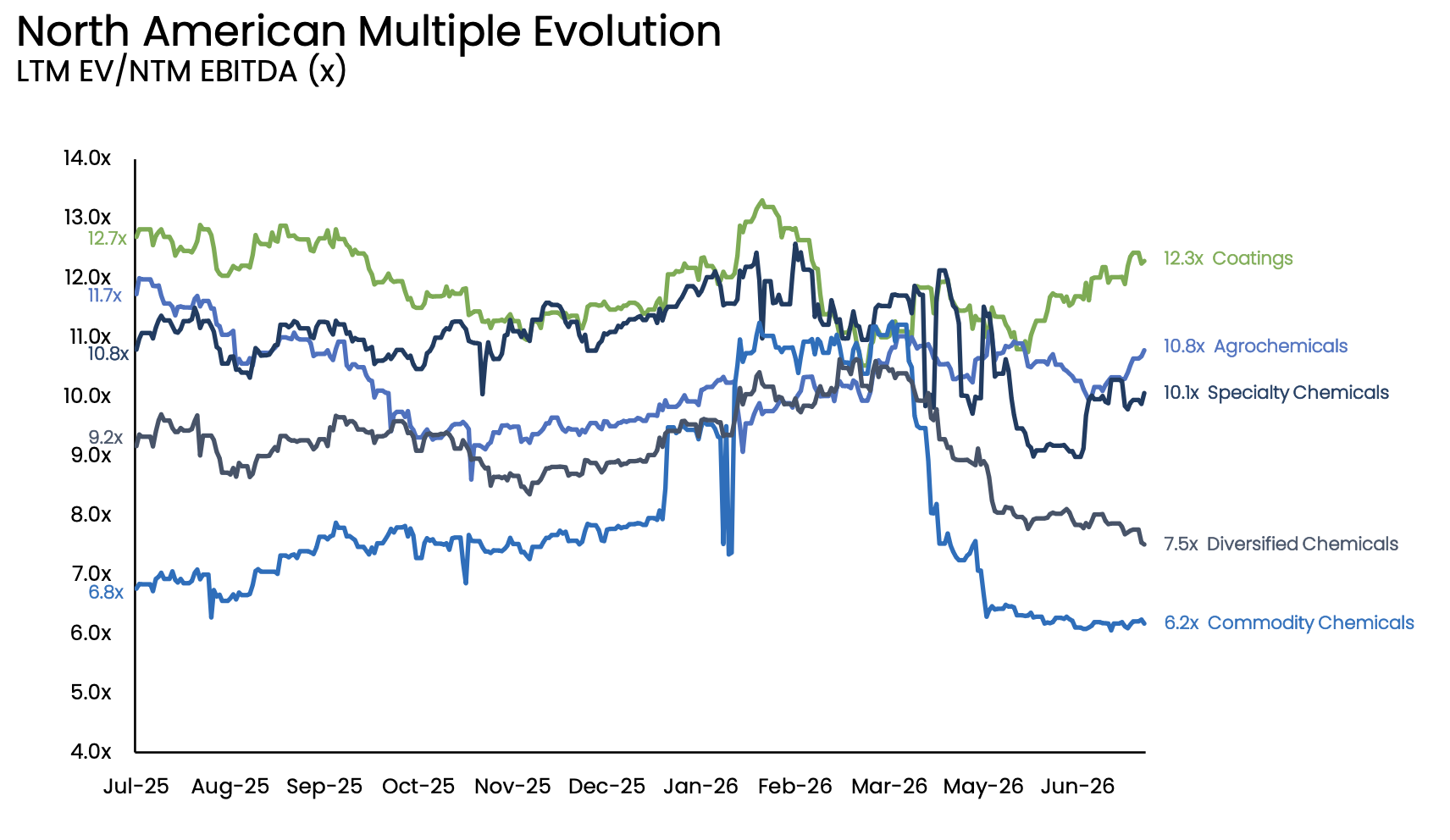
Commodity biz’s going cheap (Jim Ratcliffe would agree)
Some thoughts and questions from the tables (please opine if you like!).
1) Clariant is trading at 5.9X and Croda at 11.0X with a market cap around twice Clariant. Should Croda buy Clariant?
2) How come Brenntag trades at 7.8X and IMCD at 11.0?
3) Evonik is trading at 5.2X and BASF at 8.4X. Maybe BASF should … oh wait sec! See story below.
So BASF acquires Evonik – well, no not yet. But it’s under discussion according to numerous press reports that you’ve no doubt read. I think they should do it. And I think Evonik should decline in the hopes of getting a bidding war going with other interested folks, from further afield - eastward. Here’s what’s interesting and what I alluded to above. It’s that M&A magic when a bigger company with a higher P/E buys a smaller one with a lower P/E and the combined entity trades at the bigger company’s multiple. You’ve magically created additional value out of the smaller company’s earnings. I think it only works when the size different is huge. BASF is about €60 Million in revenue Evonik is €14 Million, so I’m not sure that’s a big enough difference – ie Evonik is too big and the market will think it’s a distraction for BASF and maybe they can’t add any value so their stock price will get dinged. What do you think? On the business fundamentals of this deal, I don't have anything clever to say, beyond what hundreds of people have copy-pasta’d into Linkedin from ChatGpt, so perhaps someone can write in with something clever (and original) and I’ll put it in next month’s blog.
And of course my silly idea about Croda and Clariant is, well, silly as Clariant’s about twice the size of Croda. I would love to see them try it though. Gamestop is making a bid for Ebay, so…. But I think Croda’s shareholders would have a metaphorical heart attack. I can’t help thinking that maybe the Croda management can argue that they are turning things back around and running a kick-ass specialty chemical company and they could bring some of that turnaround-kick-assery to the larger target. That’s the Gamestop argument. Speculation and it’s not going to happen, probably.
The great ACI sent me an interesting report that they commissioned relating to the economic role of the cleaning products industry in the US. There’s a link to it on this page https://www.cleaninginstitute.org/newsroom/2026/new-report-us-cleaning-products-sector-directly-generates-885-billion-economic-output . OK let’s take a look at some key points – first relating to surfactants, because we are a bit surfactant-centric here. :
Surfactant manufacturing generated $8.5 billion in direct US economic output in 2025.
Surfactants contributed $4.48 billion in value added to the U.S. gross domestic product.
Direct employment in surfactants totaled 4,622 workers, supporting 8,000 total jobs across the supply chain through a 1.72x employment multiplier.
The surfactant segment supported $1.0 billion in labor income and generated $0.57 billion in tax contributions.
China supplied $194.5 million in “surface-active preparations” to the U.S. in 2025, exposing domestic manufacturers to elevated supply chain costs via tariffs.
Canada received 71% of U.S. “exports of surface-active preparations”, with secondary markets extending to Australia and the United Kingdom.
Interesting right? OK – Now the overall industry key points:
The U.S. cleaning products industry produced $88.5 billion in direct economic output and $103.6 billion in total economic output in 2025.
The sector supported 124,298 total jobs nationwide, which includes 64,681 direct manufacturing positions.
Industry operations generated $15.1 billion in labor income and $6.4 billion in federal, state, and local tax revenues.
U.S. consumer retail sales for cleaning products reached $43.8 billion in 2025, representing a 3.1% year-over-year increase.
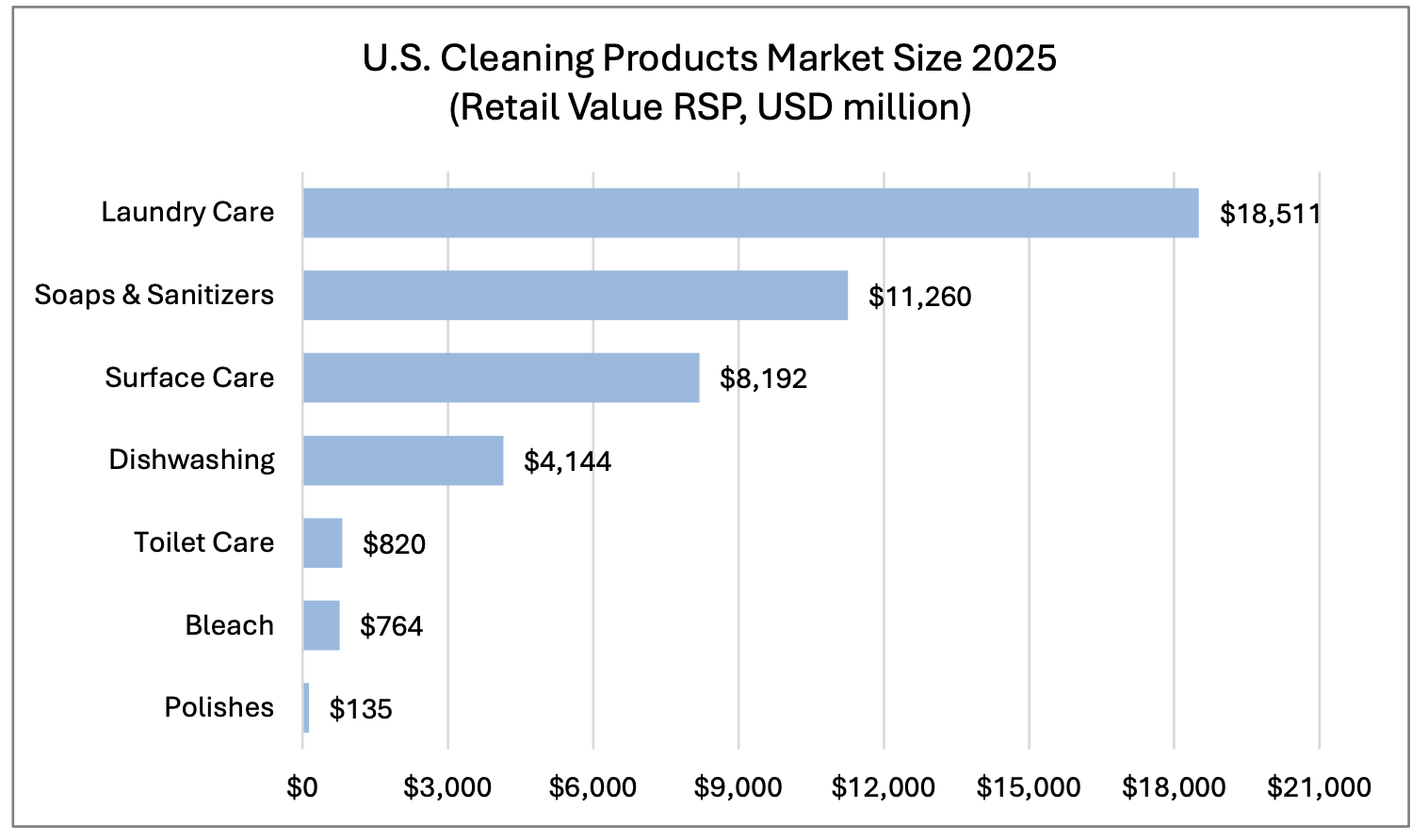
Fabric care represented the largest consumer retail category, recording $18.5 billion in sales.
The report’s pretty nice. Some great charts and graphs in there and it’s a great source of reference. Here’s one, just to give you a taste.
OK – here’s a trivia question from the report. Which of the 50 states reports the highest cleaning products direct economic output? No, it’s not California – although that is #2. However at #1 with more $13 Bn, more than 2 X CA, is Ohio. How come? You know! Of course you do. Who’s HQ’d there?
I read on Linkedin and elsewhere that Jia Zhang Lee has been apointed Chief Executive Officer of Kuala Lumpur Kepong Berhad (KLK), effective 1 October 2026. Mr. Lee, who currently serves as Chief Operating Officer, will be redesignated as CEO as part of the Group’s orderly leadership transition. Congrats JZ! More details here: https://www.klk.com.my/wp-content/uploads/2026/09/2026-09-09-KLK-appoints-Lee-Jia-Zhang-as-Chief-Executive-Officer.pdf
More people news: Jennifer Zientek who many of you know from her time at Syensqo in the HPC surfactants / amines area has just taken on the President and COO roles at Presperse (color dispersions). Congrats Jennifer! More here: https://www.presperse.com/presperse-corporation-appoints-jennifer-zientek-president-chief-operating-officer/
And even more people news: Unger Fabrikker has just appointed Thor Erik Nyseth as CEO. That’s really great to hear. Many of you know Thor and Unger from my conferences and the ACI.
As I peruse my well-thumbed copy EHS Leaders magazine, I see that the EPA is expanding non-animal testing options for chemicals, including surfactants. The surfactant related part concerns potential inhalation effects of certain surfactants under the Toxic Substances Control Act (TSCA). Interesting. Let’s look closer: Some surfactants can irritate or damage respiratory tissue when inhaled, making inhalation effects relevant when the EPA evaluates potential risks associated with a new chemical. The EPA’s New Chemicals Division issued an implementation memo (https://www.epa.gov/system/files/documents/2026-08/surfactant-implementation-memo_final-8-27-26_signed.pdf) in August describing an alternative method for assessing potential human health risks from certain surfactants. The approach combines testing using three-dimensional human airway tissue with computational modeling. The EPA also released supporting evaluations using two surfactants as examples—Triton X-100 and oleoyl sarcosine—and a structural classification guide (https://www.epa.gov/reviewing-new-chemicals-under-toxic-substances-control-act-tsca/new-chemicals-division-reference) to help Agency reviewers determine whether other surfactants fall within the chemical classes the approach applies to. [Interesting that they choose Nonyl Phenol Ethoxylate and Oleyl Sarcosine. Not exactly mainstream surfactants are they? Can someone shed light on this? BTW I notice that the EPA’s data evaluations were sponsored by PETA Science Consortium International, which is headquartered in Stuttgart, Germany. What’s with that? ]
Metathesis watch: ICIS reports that Verbio is starting up its new ethenolysis plant in Bitterfeld, Germany. The plant uses rapeseed to produce 1-decene and 9-decenoate methyl ester (9-DAME). Capcity is 60,000 tonnes/year. 1-decene is mainly used to produce polyalphaolefins (PAO), which are used as group IV lubricants. 9-DAME has applications in surfactants, lubricants, polymers and other specialty markets. And and – on October 6th, I will be a keynote speaker, alongside the great Professor Richard Schrock at the plant’s ribbon-cutting. Schrock is a big deal in chemistry. You can read about him on Wikipedia https://en.wikipedia.org/wiki/Richard_R._Schrock . My Wikipedia page seems to be off-line.
The surfactants from thin air movement gathers momentum. Econic has a new tech brochure which they’ll give you in exchange for your email here https://www.econic-technologies.com/surfactants/ . Some interesting data in there but no INCI name(s) yet. I’ll tell you as soon as I know.
I have been known to enthuse about wood from time to time – as a potential surfactant feedstock and I have been a big champion for (and advisor to) Dot Ingredients of New Zealand and their cellulose nanoparticle technology. This academic paper (https://link.springer.com/article/10.1007/s44405-025-00021-0) reviews structural and chemical engineering strategies for stabilizing Pickering emulsions utilizing cellulose nanocrystals and cellulose nanofibrils. Methodologies such as ionic cross-linking, chemical surface functionalization, and membrane engineering resolve inherent material limitations by improving interfacial adsorption energetics and mitigating internal phase leakage (phew!). Target commercial applications encompass pharmaceutical delivery, food preservation, and cosmetic formulations. Other folks in the cellulose particle and or crystal field include Borregard, Sappi and Celluforce. Keep an eye on this. !

What’s your Wood Strategy?
Market News:
Asian fatty alcohol ethoxylates spot and import prices trended downward, pressured by falling upstream palm kernel oil and mid-cut fatty alcohol feedstock values. Regional buying interest retreated into a wait-and-see stance, reinforced by a seasonal demand slowdown surrounding Chinese autumn and national holidays. Meanwhile, broader Chinese factory activity showed expansion, though spot transactions toward the Middle East faced headwinds from elevated shipping rates linked to ongoing regional conflict. Upstream palm complex indicators point toward increased production alongside contracting exports, adding further downward pricing momentum across the derivative supply chain.
Global fatty alcohol markets.:
In Asia: Asian spot prices for mid-cut fatty alcohols extended their downward trajectory, pressured by falling palm kernel oil feedstock costs across Malaysia and Indonesia. Long-chain fatty alcohol valuations declined across the board amid off-peak seasonal demand and cheaper palm stearin costs, while short-chain variants held flat. Procurement activity slowed as buyers retreated during Chinese national holidays, though market participants anticipate post-holiday restocking. Upstream palm oil reserves expanded amid higher output and reduced exports, even as Indonesia implemented a higher nationwide biodiesel mandate expected to absorb domestic feedstock and limit regional export availability. Regulatory developments include an extended European Union compliance timeline for palm-derived oleochemicals and a postponement of Indonesian natural resource export restrictions
In Europe: Mid-cut fatty alcohol spot prices softened following a sharp drop in upstream palm kernel oil values, though regional suppliers resisted significant discounting due to elevated existing inventory costs and underlying supply tightness. Buyers paused fresh commitments in anticipation of lower prices, whereas sellers held forward delivery offers steady as non-compliant legacy stocks face approaching entry deadlines ahead of deforestation mandates. Inland waterway transportation faced critical operational disruption as River Rhine water levels dropped to a record low, severely impairing barge transit. Key regulatory updates include the European Union expanding deforestation rules to encompass palm-derived oleochemicals under an extended compliance grace period, alongside a postponement of planned Indonesian natural resource export restrictions.
In the USA: Mid-cut fatty alcohol availability expanded entering the final quarter of the year, providing spot buyers increased flexibility, while longer-chain blends remained comparatively tight and specific single-cut alcohols stayed readily available amid soft downstream consumption. Feedstock palm kernel oil valuations fell sharply after a sustained peak, dampening purchasing interest across downstream lauric products and driving natural and synthetic alcohol prices closer to parity during contract negotiations. Although regulatory tariff exemptions on pure-cut imports alleviated some duty burdens, persistent container shipping expenses and logistics lead times continue to sustain delivered costs. Upstream energy price gains were capped by restored regional infrastructure and elevated maritime transit through the Strait of Hormuz, whereas chemical ethylene spot values began weakening. Looking forward, market participants anticipate potential agricultural yield reductions stemming from an active El Niño climate cycle.
The Asian linear alkyl benzene (LAB) Market displayed a firm to upward pricing trend supported by snug spot availability, elevated feedstock kerosene and benzene costs, and ongoing Middle East shipping challenges. Demand in India strengthened following the conclusion of the monsoon season, though regional transactions remained constrained by limited spot inventories. The linear alkylbenzene sulphonate market held steady as producers rolled over offers against cautious buyer sentiment, while suppliers considered upward revisions to preserve operating margins. Regional production faced restrictions from scheduled turnarounds and operational snags in India and China, including maintenance at Nirma and Fushun Detergent Chemicals alongside reduced operating rates at Jintung Chemical. Upstream energy and shipping markets remained influenced by persistent geopolitical tensions following stalled negotiations over maritime transit through the Strait of Hormuz.
In Asia's fatty acids : Spot prices experienced across-the-board declines, driven by plunging upstream palm kernel oil feedstock costs and sluggish buying demand. Valuations for lauric, myristic, stearic, and short-chain acids dropped as suppliers lowered offers amid expanding crude palm oil inventories and softer export shipments. Purchasing activity stalled as buyers retreated during Chinese autumn holidays, though market participants expect post-holiday inventory restocking. Regional palm consumption finds support from Indonesia's expanded nationwide biodiesel mandate, which is projected to curtail export availability. Key regulatory news includes the European Commission extending deforestation rules to encompass palm-derived oleochemicals under a delayed compliance schedule, while Indonesia postponed planned export controls on natural resources.
Next and last up (before the music), our guest article for the month. I didn't write this but it’s still pretty good and very informative if you’re a small to mid-size company.
Guest Article
〰️
Guest Article 〰️
+++++++++++++++++++++++++++++++++++++++++++++++++++++++++++++++++
Guest Article – From Libra Speciality Chemicals of the UK
Greenhouse gas inventory in a mid-size chemical business: what it actually takes
Most guidance on greenhouse gas accounting is written for very large companies. It assumes a sustainability team, a data platform, and a budget for external verification. Mid-sized chemical manufacturers have none of those luxuries and are still asked for the same numbers, usually by customers who are themselves under pressure to report to their customers or required to by law. This piece is about what that gap looks like from a single-site, medium-sized chemical manufacturing business, and what proved useful in getting to the stage of reporting some product carbon footprints.
Where the pressure comes from
The request rarely arrives as a regulation. It arrives as a customer questionnaire, in a sustainability assessment like EcoVadis, a CDP supply chain request, or a line in a tender document. Large brand owners and retailers need product carbon footprint (PCF) data from their suppliers for their assessment of Scope 3 emissions (Category 1; purchased goods and services), so the request moves down the chain until it reaches someone who must answer it. Reporting thresholds in Europe have shifted over the past two years, but the direction of travel for suppliers has not. If your customer must report a supply chain footprint, you will be asked to contribute to it, and it starts with gathering data.
Scopes 1 and 2 are arithmetic. Boundaries are judgment.
Fuel and electricity data are usually available from bills and meters. The real work is defining the boundary: which legal entities, which sites (if multiple), which fuels, etc. Agree on the organisational boundary and write it down before calculating anything, because changing it later invalidates the baseline and every comparison built on it.
The good news is that, for most companies, the “Operational Control” boundary detailed in the international Greenhouse Gas Protocol is easy to apply. Look at where you have full control over activities, and set your boundary there, which then means that Scope 1 is quick to calculate: how much fuel have you burned physically on site? Normally, this is just natural gas, but this also includes any diesel for diesel-powered forklift trucks, so look all around.
Scope 2 can be reported in two different ways. The location-based figure uses grid average factors. The market-based figure uses contractual instruments such as a renewable tariff or REGO-backed supply. A green tariff moves the market-based number and leaves the location-based number untouched. Reporting only the favourable one is the most common presentational error in this area, so be careful where you use each number. Use location-based when tracking emissions over time, but market-based when calculating product carbon footprints.
Scope 3 is where a chemical business lives
For a manufacturer and distributor of surfactants and speciality chemicals, purchased goods and services invariably dominate the inventory. Raw materials carry the embedded emissions of their feedstock route, and the spread is wide. An oleochemical-derived surfactant and its petrochemical equivalent can differ meaningfully cradle-to-gate, and two suppliers of the same material can differ again depending on energy mix, plant efficiency, and transport distance, even if they are identical chemically.
Spend-based estimation, applying an average emission factor to each unit of spend, will produce a number quickly. However, it will not produce a number that responds to any decision you make or, perhaps, has any realistic match with “real” emissions, as it assumes that if you spend less, you emit less; often petrochemical-based, high-emission materials are cheaper than low-emission equivalents. It also makes raw material price inflation look like emissions growth, which is a difficult conversation to have with a Board of Directors.
Data quality is the real problem, not data absence
The blocker is rarely that data does not exist. It is that data of very different reliability sits in the same spreadsheet with nothing to distinguish it. Supplier-specific verified figures, supplier-specific unverified figures, secondary database values, proxies from a structurally similar molecule, and internal engineering estimates all look identical once they have been summed into a total. Getting hold of good quality data is the biggest challenge facing any company trying to calculate its greenhouse gas emissions and product carbon footprint.
Scoring each input is more productive than chasing perfection. The GHG Protocol Scope 3 Standard already sets out the dimensions: technological, temporal, geographical, completeness, and representativeness. A simple ordinal score against each, recorded alongside the value, does three useful things. It shows where the total is weak. It gives a defensible answer when a customer auditor asks how you got to the figure. And, crucially, it directs the next round of effort, which is almost always a small number of high-volume, low-confidence raw materials rather than the whole bill of materials.
Product footprints, and when to attempt them
A corporate inventory under the GHG Protocol Corporate Standard or ISO 14064 part 1 and a product carbon footprint under ISO 14067 or the GHG Protocol Product Standard answer different questions and should not be conflated. For chemicals specifically, the Together for Sustainability product carbon footprint guideline is the more practical reference, because it settles methodological choices that the general standards deliberately leave open, including cut-off rules, allocation defaults, and the treatment of biogenic carbon. Aligning with it early avoids rework when a customer asks for a figure they can compare against another supplier.
Sensible sequencing for a mid-size manufacturer is corporate inventory first, then product footprints for the few products a customer is actively asking about, then widen. Attempting a full catalogue in year one produces a large volume of low confidence figures and very little insight.
Allocation, the part nobody enjoys
Chemical manufacturing sites often produce and blend many products through shared vessels and shared utilities, without any sub-metering. Site electricity, steam, effluent treatment and cleaning between batches all have to be allocated somehow. Mass-based allocation is the usual default and is straightforward to explain. Economic allocation gives materially different answers where product values diverge, which is common between commodity blends and speciality grades. Neither is wrong. What matters is that the choice is documented, applied consistently, and disclosed, so a figure can be interpreted rather than merely quoted.
Changeover and cleaning losses deserve separate measurement. On short runs, they are frequently a larger contributor than expected, and they are one of the few areas where an operational change shows up in both the cost and the carbon number.
Where the numbers actually move
Three levers tend to dominate for a business of this type, and only one of them sits on site. Feedstock and supplier selection is upstream and usually outweighs everything happening inside the factory gate; it would be surprising if any chemical manufacturer’s Scope 3 Category 1 (purchased goods and services) emissions are lower than 80% of the total. Electricity contracting changes the market-based figure quickly and cheaply. Logistics and format change the transport contribution, since bulk packaging options, including ISO tanks, flexitanks, and 1000 kg IBCs move considerably more product per movement than smaller formats like 200L drums. Yield, rework, and batch size sit alongside these and are worth tracking because they push cost and emissions in the same direction: down.
Honest limits
Primary supplier data remains patchy, particularly for imports from outside Europe and for materials bought through distribution. Secondary datasets are revised on their own schedule, so a calculated footprint can change without anything physical changing. That makes year-on-year comparison fragile unless recalculation rules are agreed in advance and stated. Anyone presenting a product carbon footprint as a precise figure, without a stated boundary, method, and data quality position, is claiming more than the exercise supports.
A closing observation
For our part, we built a product carbon footprint framework with a data quality scoring layer attached to every input, on the basis that a transparent figure with moderate confidence is more useful to a customer than a confident figure with no provenance. It is not finished, and we do not expect it to be until there is robust data all the way back up the supply chain shared with customers downstream. Other mid-size manufacturers that we network with have reached similar conclusions from quite different starting points, which suggests the constraint is structural rather than particular to any one business.
The workable position for a company of this size is probably this: publish what you can defend. Mark clearly what you cannot. Improve the inputs that matter most, first. Because some decent data is better than publishing inaccurate or no data at all.
Libra Speciality Chemicals is a UK manufacturer and global distributor of surfactants and speciality chemicals, with toll and contract manufacturing capability at its site in Irlam, Manchester. It is part of the GRI Group, holds ISO 9001, ISO 14001, and ISO 45001 certification, and is a member of the BCMPA.
+++++++++++++++++++++++++++++++++++++++++++++++++++++++++++++
End of Guest Article
〰️
End of Guest Article 〰️
The Music Section
Man, I couldn't think of what to put in here, sitting here in the backyard enjoying this crazy NJ Indian summer we’re having. Then what happens: Of course, lawnmowers, strimmers, hedge clippers – all start up as the swarms of landscapers descend on our suburban idyll. This is the sound of the suburbs.!
Hey but they had some other great songs didn't they? Ever been in love with a working girl? Tell us about it (anonymity guaranteed).
This one captures something about a certain type of life. Solitary Confinement. Listen to that spoken interlude. Sad right?
Similar vintage: The Skids – Into the Valley
If you were listening to John Peel back in those days you also got this one from the delightfully named Splodgenessabounds. Did you ever have this problem in a pub where you weren’t a regular and everyone else was?
Looping back to the working girl theme: I fell in love with a female plumber from Harlesden NW10 (I can’t wait to see her again). If you have ever done this, for real, I urge you to write in and tell me about it. We’ll reprint (anonymously if needed) in the blog. We’ll tie it back to surfactants. Don’t worry.
If your plumbing went awry you may find yourself throwing your baby out with the bathwater
But perhaps your paramour is of a more artistic bent? I love my baby ‘cos she does good sculptures…
That’s it!
When will I see you again? October 27th – 28th in Kuala Lumpur of course https://events.icis.com/website/14105/home/
Our hearts will beat together!