
We had a great time in Kuala Lumpur for the 12th ICIS Asian Surfactants Conference, co-produced by me on Tuesday October 27 – 28th, preceded by the one day surfactant business essentials training course. We got into a lot of in-depth analysis and discussion of the fatty alcohols value chain and LAB plus a whole lot of new technology. I can’t remember a recent event (one of my own or any other) at which I personally learned so much. I recorded the video below, onsite just after the close of the conference. Watch (actually you can just listen. It’s just me talking) carefully. There’s a lot going on right now.
Our next in-person live event is the flagship 17th World Surfactants Conference, May 20 – 21st in Jersey City, with the One Day Surfactants Course on May 19th. Buy now (both course and conference for a special price) and save a ton money with the early bird rates. https://events.icis.com/website/8544/
End of commercials.
The News:
Earnings time again.
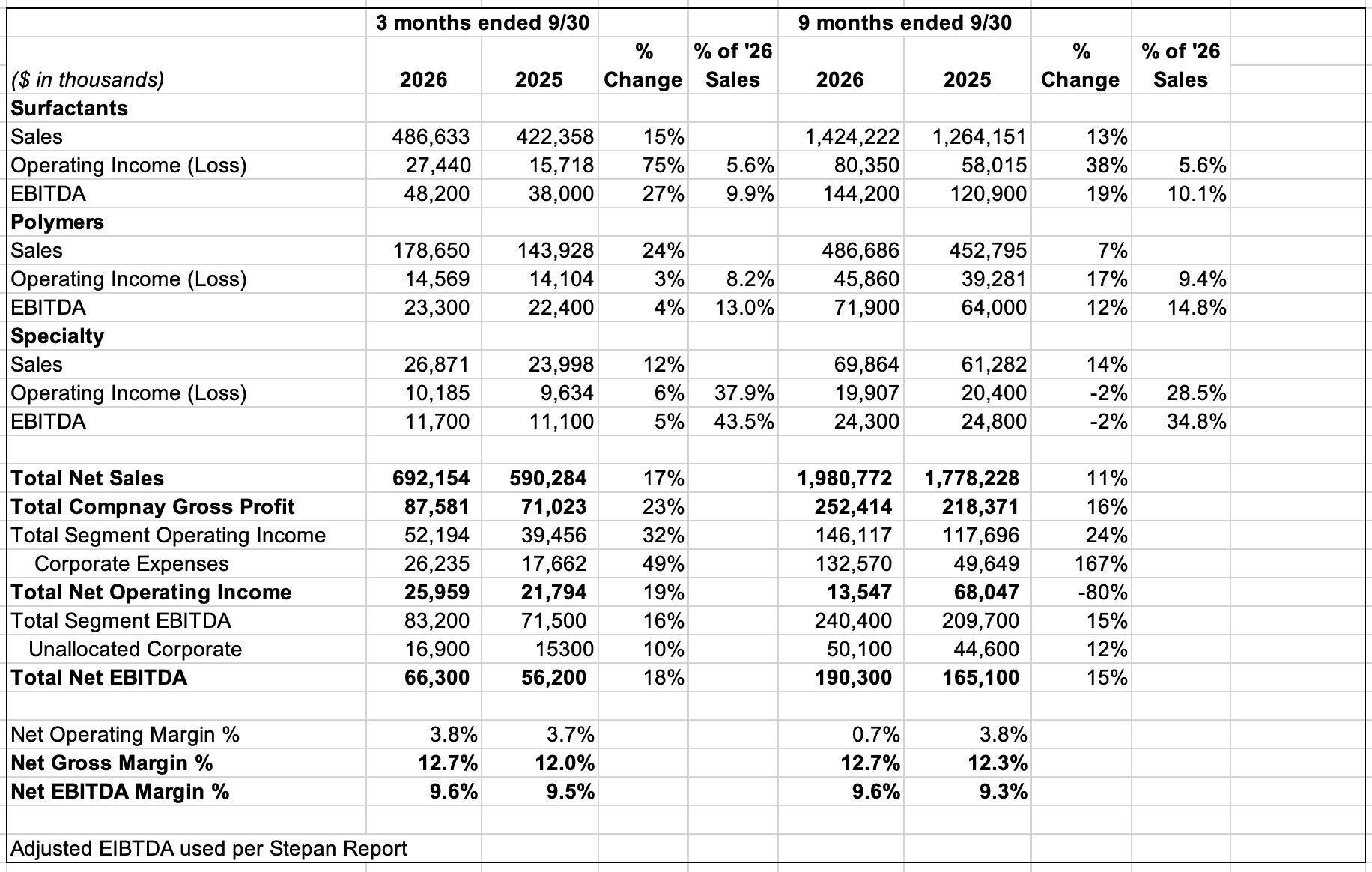
First up Stepan: Stepan had a pretty good third quarter and year to date was not bad at all for the company as a whole:
Year to date (9 months):
· Reported net income was a $0.7 million loss versus $41.9 million of income in the prior year. The current year loss is entirely due to a $76.1 million pre-tax restructuring charge. The cash impact associated with this restructuring charge was approximately $12.8 million year-to-date. Adjusted net income was $59.1 million, up 40% versus the prior year.
· EBITDA was $110.1 million and Adjusted EBITDA was $190.3 million. Adjusted EBITDA was up 15% year-over-year.
· Organic sales volume was up 4% year-over-year.
The surfactants business at Stepan seems to be back on a decent track and the company is seeing some results from their Project Catalyst cost savings program. According to the company “Consolidated adjusted EBITDA increased $10.1 million, or 18%, in the quarter. This increase was primarily due to higher Surfactant earnings driven by sales volume growth and margin recovery. Surfactant net sales were $486.6 million for the quarter, up 15% versus the prior year. Selling prices were up 10% primarily due to pass through of higher raw material costs and pricing actions. Global Sales volume was up 3% and organic sales volume increased 8%. Double digit growth in the Consumer Products, Construction & Industrial and Oilfield end markets and to our Tier 2/3 customer base was partially offset by lower Crop Productivity demand. Foreign currency translation positively impacted net sales by 2%. Surfactant adjusted EBITDA for the quarter increased $10.2 million, or 27%, versus the prior year. This increase was primarily due to sales volume growth and margin recovery.”
I put together the following table (by hand, not AI. You’re welcome!) from the results. And look, they came into 2026 with a lot of challenges. I think they should be quite pleased with how the year has gone, especially in the face of the gulf war disruptions. They’ve seen volume and margin growth and some modest margin expansion.
Solid Progress by SCL
As always from the earnings call, we glean more interesting information:
· Stepan offset higher raw material costs through targeted pricing actions and contractual pass-through mechanisms.
· In Q3 2026, selling prices increased 10% in Surfactants and 22% in Polymers primarily due to these pass-throughs. The Pasadena, Texas facility ramped up production to 75%–80% capacity utilization, generating supply chain and tolling cost savings under Project Catalyst.
· Stepan is tracking ahead of its 60% ($60 million) 2026 pre-tax savings target from its two-year $100 million plan, now projecting $66 million to $70 million for full-year 2026. The Q3 2026 savings run rate reached $23 million. For 2027, management expects to exceed the $25 million quarterly average run rate goal by $2 million to $3 million, with the first half of 2027 running slightly below $25 million per quarter and the second half exceeding $25 million as Pasadena production and pipeline projects ramp up.
· Year-to-date, Surfactants grew EBITDA across all regions (North America, Latin America, and slightly in Europe), supported by market share gains and Tier 2 and Tier 3 customer expansion (over 300 new customers and nearly 900 new customer-product combinations year-to-date).
· Agricultural / Crop Productivity Demand: While Q3 crop productivity volume declined (particularly in Europe), year-to-date performance remains positive. Despite macroeconomic pressures and fertilizer price challenges affecting major agricultural customers, Stepan is targeting market share gains with multinationals and Tier 2/3 accounts. Management highlighted expansion into tank mix adjuvants, noting a $1 billion market in the U.S. and a $700 million market in Brazil where Stepan is in the early stages of growth.
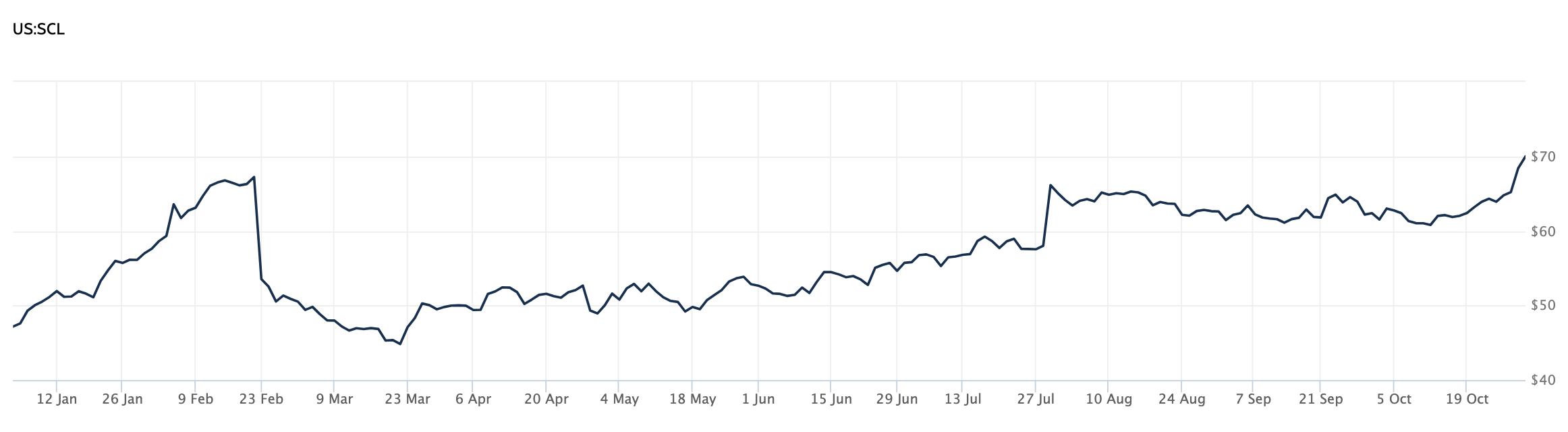
So again, pretty good progress over at SCL. The market agrees and the stock got an earnings day pop. Here’s SCL year to date, up 47%. Gotta be feeling OK there in Chicagoland.
Pop! on 10/28
The BASF and Evonik story that we wrote about last month is evolving into a bit of a soap opera (by German standards anyway!). OK, I’m exaggerating and probably betraying what I would like to see. Anyway, some further developments. Reuters reported that BASF has raised it’s offer from €22.15 to €24 per share, which would value the target at €11.18 billion ($12.43 billion). BASF’s CEO also said they wouldn't overpay for Evonik, so that’s good I guess. Separately, it was reported that the German state of North Rhine-Westphalia, where Evonik is based, said that jobs and the independent development of the company must not be jeopardised by a takeover. The state could have significant influence, because state premier Hendrik Wuest sits on the board of trustees of RAG Foundation - Evonik’s largest shareholder. BASF has stated that they layoff anyone at Evonik in Germany through 2032 if the acquisition goes through. Interesting. So all “synergies” come from ROW and the BASF side, a cynic would say. Anyway, Reuters now predicts this bid too will be rejected. Surely there should be other bidders out there? Although buying into Europe, from the outside may not be that attractive these days. This seems like more of a defensive consolidation to me .Too harsh? What do you think?

German Soap Opera?
BASF also reported quarterly results. I’ll do a deeper dive into Care Chemicals at end of year. In summary, the company overall did OK. The Iran war has given them a bit of a boost driving up local demand even as energy prices rocketed. BASF booked sales of €16.4 billion in the third quarter, nearly 5% more than analysts polled by the company had expected, driven by price increases aimed at offsetting energy costs and, to a lesser extent, improving volumes. The company said it expected its adjusted core earnings to land between €7.4 billion and €7.8 billion ($8.2 billion and $8.7 billion) this year, up from the range of €6.9 billion to €7.7 billion it had given in July. In Greater China, sales grew by around one-third, led by 20% growth in sales volumes. Not too bad, given the notoriously overbuilt chemical sector there. BASF's agricultural business, which it plans to list on the Frankfurt stock exchange, was the only outlier, with a 20% sales decrease vs last year. The company aims to spin off the business via IPO by mid-2027. BTW, competitor in ag, Syngenta also plans an IPO in Hong Kong next year.
And P&G: Their first fiscal quarter of 2027 just ended 9/30/26. It was pretty good. Earnings and revenue beat analysts’ expectations, fueled by growing demand for its laundry detergent and home care products. Shares of the company rose more than 5% in response.
Earnings per share: $2.00 adjusted vs. $1.88 expected
Revenue: $23.3 billion vs. $22.8 billion expected
P&G’s top-performing division was fabric and home care. The segment’s volume rose 4.3% in the quarter, helped by stronger demand for laundry detergent and fabric enhancers. The baby, feminine and family care segment and its beauty business both reported volume growth of more than 2%. P&G’s grooming division (razors mainly) saw volume shrink 0.4% in the quarter. Healthcare volume fell 2.9% as demand for oral healthcare products, like Crest and things like Pepto-Bismol, shrank.
P&G has previously said that consumers are now using every last drop of shampoo or laundry detergent, and value packs have become more popular. In fiscal 2026, P&G reported just one quarter of volume growth. They still see a bifurcated economy (that’s the rich and the rest). High-income consumers are willing to trade up to new products, even a $30 shampoo, while low-income consumers are trying to make brands like Tide and Pampers work for their tight budgets. Hmm OK well let’s see. $4 plus gasoline has a lot do with this I’m sure.
Clorox has a new CEO, effective next year. He is Fabian Garcia, currently president of Unilever Personal Care and a member of the Unilever’s executive team. Before joining Unilever in 2020, he was CEO of Revlon and served as chief operating officer for global innovation and growth at Colgate-Palmolive. Much success!
It pains me to write this but WTH (What the Heck) Croda!? The UK Daily Telegraph, in its business section wrote a piece headlined “How Ozempic Face Could Revive a British Giant”. The sub-head reads “Use of fat jabs is opening promising doors in beauty for fading chemicals firm Croda.” I added the bolding there to make sure you saw it. The article features a large photograph covering ¾ of its area of what appears to be a Halloween ghoul but upon closer reading turns out to be Sharon Osbourne, widow of the late great Ozzie. There’s also a much smaller passport-size photo of the Croda CEO. Now, the article itself is not horrendous, once you get past the first sentence which reads “A surprise discovery may have saved one of Britain’s oldest chemical companies from sliding into irrelevance”. So if I only got to the headline (most readers probably), I take away that Croda is fading and if I take a glance at the article, my first message in the first sentence is that the company is basically irrelevant. If I make it to the end, the parting shot is that Croda is an old dog (albeit with some life in it yet). The article talks about the skin-plumping chemical Volufilline which is proving popular as a remedy for the much publicized Ozempic face, as sported by Sharon in the photo. Fine. We wrote about this in the blog some years ago. But here’s the thing. Croda actually posted this entire article, headline, photo and all on Linkedin. Not sure I would have done that. Did they try to contest this unfair characterization of their company before publication? Maybe they did, to no avail. Maybe not possible. Could they then not at least have accompanied the post by a copy of their letter to the editor (good naturedly but firmly) pointing out that they are turning things around across the board and well on their way back to being among the most profitable specialty chemical companies in the world? And also, BTW not reliant on a single beauty fad. And failing all that, could they not have at least pushed back (again good naturedly if they want) agains the fading, irrelevant, old-dog blather. We wrote favorably about their turnaround a couple of months ago. I have always admired Croda’s marketing. This time though… C’mon guys! Too harsh (again)? Here’s that LI post https://lnkd.in/p/dbZtx6mq Let me know your thoughts.

It bothers me.
Clariant has launched two products, GlucoTain Sense and GlucoPure Sense. They are both based on Sunfloweroyl Methylglucamide (That’s the INCI name), derived from sunflower oil. The hydrophile (my assumption) is from glucose and there’s an amide link. The Tain is for personal care and the Pure is for HI&I. That’s a promising supply chain, especially for Europe. I wish them luck.
Personal Care Insights magazine has reported that Kale Care Chemicals, a Turkish chemical raw materials and ingredients company, has invested in surfactant production with a second facility in Gebze, Turkey, boosting the company’s total annual production capacity to 100,000 MT/yr. This includes preservation sytems as well as surfactants. Their process capabilities look more in the line of batch specialties, esterification, oxidation, alkylation, quaternization etc. Not sulfonation or ethoxylation. Now you know as much as I do.
In other plant expansion news, Oleon has added a specialty ester production unit to its Conroe, TX site. Markets served include lube additives and the oil and gas field.
And in yet more, BASF officially opened its Cincinnati APG capacity expansion which was announced in 2023. They also make APGs in Germany, China and Thailand.
We occasionally write about the SCC (Society of Cosmetic Chemists) here. It’s a great organization and I’ve spoken to some large groups at their chapters in Illinois and California recently. HAPPI reported on the SCC’s newly elected officers and I thought you’d like to see them here. May be some folks you know.
President – Perry Romanowsky, Element 44, Inc. (His 2nd stint as President)
Vice President – Valerie George, Simply Formulas
VP Elect – Amy Marshall, Eckart America / Byk USA
Secretary – Mindy Goldstein, Mindy S Goldstein, PhD Consulting
Treasurer – Caryn Weiss, Amway Corp.
The great Doris De Guzman wrote a great article on her blog about the recent Renewable Materials Conference in Germany. The first sentence sums things up very well. It reads, in part “…the renewable materials industry does not appear to be short of technologies. What it remains short of is a reliable system for turning those technologies into competitive, financeable and scalable businesses.” Surfactants got a mention in the form of Viridi, which was voted Renewable Material Company of the Year at the Conference. Blog readers will recall that they are building surfactants from carbon dioxide using a copolymerization catalyst. Econic is the other company in this space and they recently presented some interesting performance data in rinse-aids, cosmetic emulsions and laundry detergent. It’s an interesting blog post from Doris. You should check it out.
You should also know that Doris published the definitive market report on renewable surfactants earlier this year (with minor assistance from me). It covers everything from fermentation to the aforementioned carbon capture. There’s nothing else out there like it. Get in touch with her if you want to buy it. info@greendma.com or admin@greendma.com. Tell her I sent you.
Speaking of biosurfactants: Did you know about BioSurfZ (https://www.bio-z.de/projekte/biosurfz/)? My German is a little rusty (actually barely existent though I’m told my accent’s pretty good) but it’s a research project funded under the German Federal Ministry of Research, Technology and Space (BMFTR) program "WIR! – Change through Innovation in the Region" and the "BioZ" innovation network. The initial consortium includes the Fraunhofer Institute for Interfacial Engineering and Biotechnology IGB, which also serves as project coordinator, Reploid, Fuse, IFX and ALTATEC GmbH of Leipzig. BioSurfZ will take a biotechnological production process developed at laboratory scale and advance it to pilot scale. The partners will also adapt the process to run on regional side streams and residual materials. Cool. I look forward to updates. Tip-line works across the whole EU.

Calls accepted from pretty much anywhere
Speaking of Leipzig, I was there a few weeks ago. It’s like the Asbury Park of J. S. Bach, where he achieved renown as music director at Thomaskirche (so I guess - his Stone Pony). I wasn't there for JSB (although I did see the church and the museum). I was a guest speaker at the opening of a new chemical plant in Bitterfeld near there. The company is Verbio and the process converts rapeseed biodiesel into 1-decene and 1-decenoic acid methyl ester (1-Dame) at a 60,000 MT/yr scale. It’s a metathesis process using a Schrock catalyst. Dr. Richard Schrock won the Nobel prize for this work and he was the other speaker. This is the first plant of its type in the world. The technology has a long history and interesting story. Needless to say, I was thrilled to bits to speak alongside a Nobel prize-winner. Who’d have thunk it? It was a great event at which I was pleased to see a number of familiar faces. I wish the project much success.

Many illustrious people there … and me.
We don’t necessarily report on all of these but this is significant. INEOS Oxide around the middle of the month, declared force majeure on ethylene oxide (EO) and EO derivatives from its Bayport, Texas, site, according to a customer letter. The site apparently suffered unexpected equipment failure and machinery malfunction, impairing the manufacture and supply of the company's EO and EO derivative products from the facility. ICIS data has the capacities there as EO – 365,000 MT, Ethylene Glcols – 320,000 MT and Glycol Ethers – 135,000 MT.
I got an oleochemical newsletter sent to me by Triact. It’s good. In it they give a good summary of the status of EUDR. It will finally come into effect on 30th December 2026 for large and medium operators and 30th June 2027 for small and micro. It gives a good accounting of the systems and processes to follow the law. Even though the infamous Annex 1 has been amended to address some of the large loopholes allowing palm and PKO derivatives to bypass EUDR it still seems a very loopholey to me. And this new Annex 1 only comes into effect at the end of 2027. So From 30 December 2027, the Annex 1scope expands to additional specified palm-derived products, including esters, alcohols, amines/quats, soaps and polyethers and ether sulfates. Coverage depends on the exact CN code, product description, palm origin and applicable exclusions. So it looks like some wiggle room there. BTW the CN code is an EU code that adds to digits to the Harmonized Tariff System code for EU tariff and other data gathering purposes. Get to know it! Digging further into the source documents (with the help of my new assistant, Argon (Google Gemini) it looks like the following are still excluded from EUDR: i) Lauryl Alcohol Ethoxylates (LAE) with 3 + moles are EO, ii) Lauryl Alcohol Sulfates (ALS/SLS), and iii) Lauryl Alcohol Ethoxy Sulfates (ALES/SLES) with 3+ moles EO. Included now in EUDR requirements (as of 12/30/27) are i) Lauryl Alcohol Ethoxylates with 1 and 2 moles EO, ii) Lauryl Alcohol Ethoxy Sulfates with 1 and 2 moles EO. Further, if sulfates, ether sulfates or ethoxylates (latter 2 with any degree of ethoxylation) are included in bar or liquid soap, those soaps are subject to EUDR as of 12/30/27. I believe this is right, but please write in and let me know if you have a different interpretation.
[Can someone suggest a humorous-ish image I can use whenever I talk about EUDR?]
In other news snippets: Galaxy Surfactants has added a new board director, Uday Kamat. Solvay has launched Solsys Care Max, a readily biodegradable oxygenated solvent designed to enhance cold-water and quick-wash detergent performance. Moldova (It’s in Europe, between Romania and Ukraine) is implementing new regulations requiring QR codes on detergent packaging to display ingredient information, alongside stricter biodegradability requirements and support for bulk refill stations to reduce plastic waste. Pet-specific laundry detergents have grown in popularity (I hope this isn’t true, but NBC reported it so…). Thankfully, veterinarians note they are largely a marketing term rather than a necessity (no kidding!), as regular detergent works fine for most pet owners. Croda (in a better article) has released a report exploring how artificial intelligence can accelerate agricultural innovation by helping researchers identify opportunities faster, extract insights from historical data, and streamline the path from research to commercialization.
Persil (Henkel) has launched Discs which claim to have addition enzyme power to get at odors inside fabric. I was able to get the ingredients by squinting at the label on the Walmart website: C12-15 alcohol ethoxylate, sodium laureth sulfate, MEA Cocoate, water, glycerin, MEA-LAS, propylene glycol, polyvinyl alcohol, PEG-10, ethanol, polyethylene imine alkoxylated, fragrance, PET, hydrophobically modified acrylate styrene copolymer, tetrasodium iminodisuccinate, Sodium C10-16 alkylbenzne sulfonate, disodium distyryl biphenyl disulfonate, protease enzyme, styrene acrylates copolymer, denatonium benzoate, amylase enzyme, colorants, mananase and cellulase enzymes. Quite a list right!? I think it’s so long partly because these discs have compartments. Maybe. I won’t get back into last month’s tortured discussion of detergent ingredient list ordering. I’d love a real laundry expert to comment on some of these components. Use our quantum encrypted tipline.

Anonymous or otherwise. Up to you.
This is interesting. The US and China agreed to reduce tariffs on $60 billion in goods, with the most relevant chemical products being US oleochemicals including industrial fatty alcohols, stearic acid, tall oil fatty acids, and sorbitol entering China duty-free. The agreement represents limited impact on broader chemical trade but provides meaningful tariff relief for oleochemical exports. I’m interested to hear from anyone benefiting from this – on the tip line, of course.

Enough tip-line photos for this monnth?
Market News:
Asian fatty alcohol ethoxylates spot markets experienced limited purchasing activity as the recent upward momentum in mid-cut fatty alcohol feedstock prices stalled. Buyers adopted a cautious wait-and-see approach regarding forward shipments, resulting in stable to soft spot assessments across both Southeast Asian and Chinese import sectors. Upstream palm kernel oil costs edged lower in Malaysia, hampering forward contract discussions. Looking ahead, market demand is expected to see support from year-end festive season restocking, while supply faces potential disruption from the El Niño weather pattern extending into early 2027. In addition, broader market sentiment remains pressured by fossil fuel volatility stemming from the United States-Iran conflict and related geopolitical escalations.
Global fatty alcohol markets
In Asia: Spot purchasing activity for mid-cut fatty alcohols remained limited as buyers paused to assess market direction amid slight declines in Malaysian palm kernel oil feedstock costs. Most buyers have fulfilled near-term inventory requirements through the end of the year, with some already securing term shipments into the first quarter of 2027. Pricing for single-cut long chains faced downward pressure from weak demand and ample supply, while short-chain C8 alcohols saw slight increases driven by perfumery demand in China and India. Market participants are monitoring potential supply constraints expected in early 2027 due to the El Niño climate pattern, alongside reduced export availability stemming from Indonesia's domestic B50 biodiesel mandate.
In Europe: Mid-cut fatty alcohol spot prices stabilized amid subdued trading, as softening upstream palm kernel oil values deterred buyers from making forward commitments. Despite this hesitancy, regional suppliers maintained a bullish outlook for early next year, offering legacy inventories at increased rates while shifting discussions for deforestation-compliant materials to the following quarter. Regional supply remains balanced to tight, influenced by scheduled facility maintenance and sold-out vendor positions, with upcoming Diwali festivities expected to further mute upstream market activity. Inland logistics face ongoing challenges as River Rhine water levels remain critically low despite recent improvements. On the regulatory Indonesia provided market relief by postponing planned natural resource export controls.
In the USA: Fatty alcohol quarterly contract prices settled higher across most grades, driven by historically elevated feedstock costs, high transportation expenses, and robust downstream demand. Conversely, mid-cut alcohol contracts remained flat. The recent multiweek rally in palm kernel oil prices stalled as values plateaued at historically healthy levels, creating volatility in production costs for vegetable-based producers. Supply chain operations remain hampered by newly imposed US customs Withhold Release Orders, with importers facing ongoing delays and weighing the financial risks of stranded shipments, though some clearance improvements have been reported.
The Asian linear alkyl benzene (LAB) Market exhibits firmness driven by constrained regional supply and elevated upstream kerosene and benzene costs. Upward pricing momentum was reinforced by a recent Chinese export tender concluding at higher valuations, though overall regional purchasing is moderating ahead of the typical year-end seasonal lull. Indian import demand has strengthened, but transaction volumes remain limited by a persistent divergence between domestic buyer indications and seller targets. Conversely, the linear alkylbenzene sulphonate sector faces firm buyer resistance to price increases, resulting in stagnant demand and the continued availability of lower-priced regional cargoes. Forward supply of linear alkylbenzene is anticipated to tighten further as multiple production facilities schedule upcoming maintenance outages, adding to ongoing logistical constraints limiting Middle Eastern exports.
In Asia's fatty acids spot trading activity remained muted as buyers adopted a cautious approach amid downward movements in the upstream oil palm complex and ongoing volatility in fossil fuel markets. Consequently, spot prices for lauric, myristic, and rubber-grade stearic acids declined across the region, while palmitic, oleic, and short-chain acids held flat with limited transactions. The market exhibits a persistent price gap between Indonesian and Malaysian cargoes, driven by differing production costs and a weakening Indonesian rupiah that prompted lower US dollar-denominated offers for Indonesian material. Moving forward, the regional market anticipates demand support from festive season purchasing in India and China, while Indonesia's B50 biodiesel mandate is expected to increase domestic crude palm oil consumption and tighten export availability.
The Music Section
I get up at 7 yeah and I go to work at 9. I got no time for living yeah, ‘cos I’m working all the time. It seems to me I could live my life, a lot better than I think I am. That’s why they call me – call me the working man!
I’ve been listening to that song by Rush for over 50 years. It’s on their first album. I’ve always assumed that it’s the typical rock song bemoaning the lot of the working man. More recently though, maybe not. Maybe it’s saying that we work because we believe we can achieve something better or even make things better. If we believe we can live a better life, for ourselves, family, community, then we will work to achieve that. That’s a much more positive spin and that’s what I’m going with for the next 50 years! And so that song was one of the musical motifs that I used at our Asian conference to illustrate our discussion of innovation. BTW some of you may remember our using that same song a number of years ago in Jersey City to illustrate the concept of continuous improvement. Multi-functional – just like many of those innovative surfactants. So this month our music is about work.
Here the original version of Working Man
And, because it’s my blog, a beautiful, rich, luxurious multilayered live version in Cleveland, 2011. Art is great, isn’t it?
Who could fail to love Styx? They were so unselfconscious, so unironic. And you know this song is not at all bad. I had the single back then. Blue Collar Man.
You could say the same about Skid Row. Totally oblivious to the sneers of the cognoscenti. Slave to the Grind. Ahh the halcyon days of hair metal.
Change of pace now. Switching smoothly to reggae- Work by Bob Marley.Good reggae is great, right?
The Clash – Career Opportunities - a crisp 2 minutes. I thought this was a bit whiney then and still do now. They made some good songs though.
We’ve had the Specials on the blog recently. Love the vibe of this. Rat Race.
Remember XTC, Making Plans for Nigel. Somewhat disturbing video (just a heads up). Note the reference to British Steel.
And of course, the Dead Kennedy’s. Take this job and erm… well. Along with the Ramones I think these guys really defined the American punk scene. And we could do an entire NSFW blog with Dead Kennedy’s tunes and videos. Thoughts? Requests?
That’s it!
When will I see you again? May 20 – 21st in Jersey City!
Our hearts will beat together!